

 240
240
 Share
Share



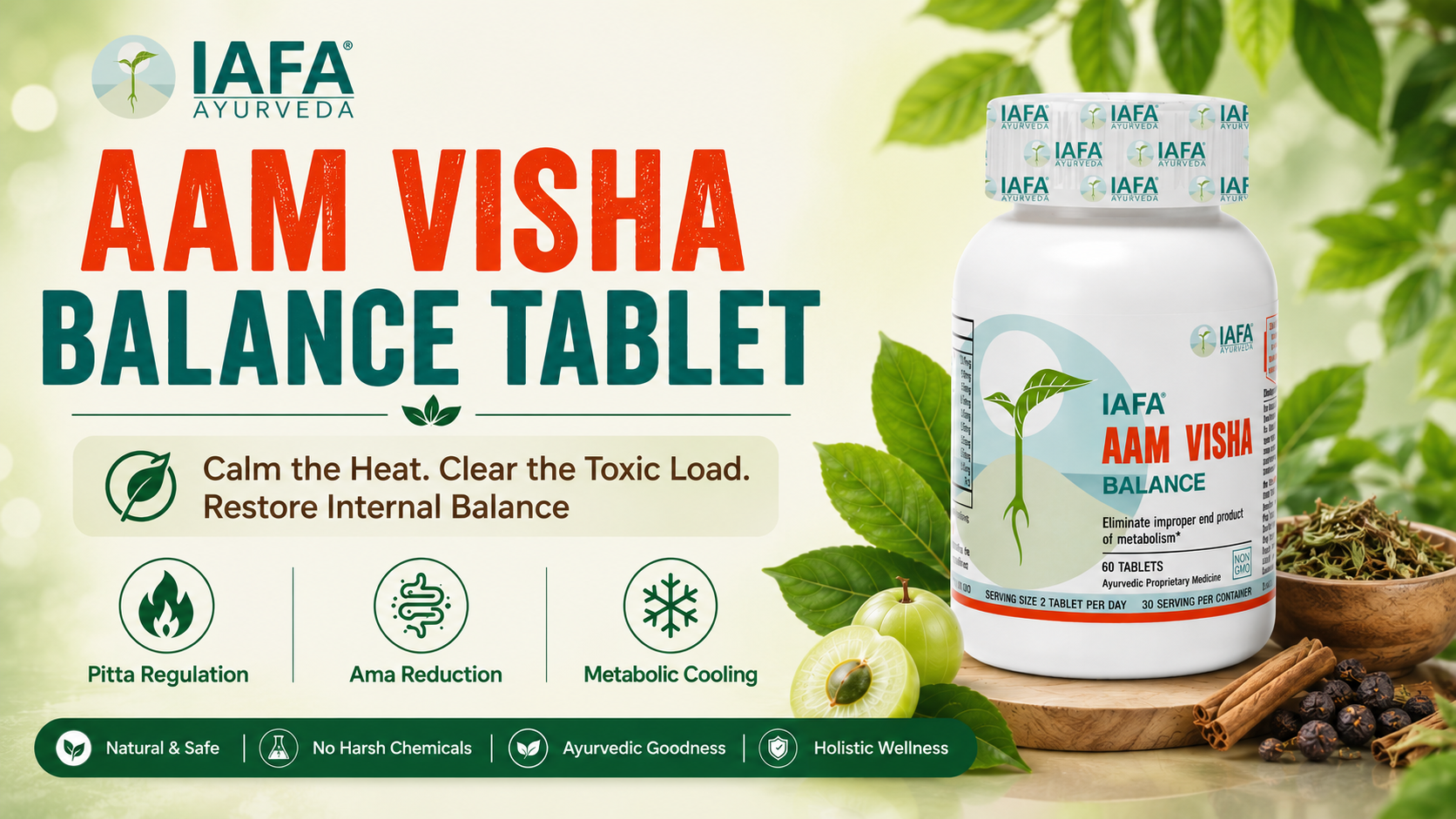
What is the Aam Visha Balance Tablet?
Aam Visha Balance Tablet is an advanced Ayurvedic balancing formulation developed for conditions where excess internal heat, disturbed digestion, Ama associated metabolic irritation gradually begin and affect the body at multiple levels.
It is not designed merely to “cool symptoms”. It is designed to calm the internal process that keeps generating them.
Many chronic digestive and inflammatory tendencies do not begin suddenly. They develop slowly when:
- Agni (digestive fire) loses balance
- Digestion becomes reactive instead of stable
- Metabolic waste starts accumulating
- Internal heat remains persistently elevated
Over time, this creates a state where the body becomes increasingly sensitive, overheated, and metabolically irritated. This may appear as:
- Hyperacidity and burning discomfort
- Heat-associated digestive irritation
- Sour reflux and gastric sensitivity
- Mouth ulcers and internal heat signs
- Food-triggered reactivity
- Heat-related skin discomfort
- Irritability and inflammatory tendency
- Heaviness associated with Ama accumulation
Aam Visha Balance Tablet is designed specifically for this kind of internal imbalance, where both excess heat and improper metabolic processing occur together. Rather than providing short-lived suppression, it works in a gradual and regulating manner. The main benefits of Aam Visha Balance Tablets are:
- Calm aggravated Pitta
- Support balanced digestive function
- Reduce Ama-associated metabolic burden
- Stabilize inflammatory reactivity
- Restore internal cooling and metabolic clarity
Because true balance is not achieved by shutting digestion down. It is achieved when digestion becomes stable, efficient, and non-reactive again.
“When metabolism stops burning excessively, the body stops reacting excessively.”
Why “Balance Tablet” Form Matters?
Not designed for temporary cooling-Designed for sustained internal balance.
Aam Visha Balance is not made as a fast-acting relief product. It is designed as an advanced tablet formulation because the conditions it targets are not symptomatic disturbances, they are repetitive metabolic patterns.
Why is the Tablet (Gulika/Vati) Form Used in Ayurveda?
In Ayurveda, Gulika or Vati Kalpana is preferred when the goal is: [1,2]
- Sustained action rather than rapid fluctuation
- Controlled administration
- Repeated daily correction
- Long-term stabilization of chronic imbalance
Unlike rapidly acting preparations that work intensely for short durations, tablet-based formulations are traditionally valued for:
- Stability of action
- Consistency of dosing
- Gradual systemic correction
- Better long-term compliance
This becomes especially important in chronic Pitta and Ama-associated conditions, where the system is already sensitive and reactive.
What Does the Tablet Form Achieve?
1. Steady Metabolic Regulation
Instead of creating sudden shifts, the formulation works gradually and repeatedly and helps to support the ongoing correction of disturbed Agni and metabolic imbalance.
2. Controlled Mineral Delivery
Mineral-based Ayurvedic preparations require:
- Precision
- Stability
- Controlled administration
Tablet form helps ensure:
- Uniform dosing
- Consistent intake
- Better therapeutic reproducibility
This is especially important in formulations designed for long-term metabolic balancing.
3. Better Suited For Chronic Pitta Conditions
In chronic heat-associated disorders:
- Excessive stimulation may worsen irritation
- Aggressive intervention may destabilize digestion further
The tablet form supports:
- Gentle correction
- Daily stabilization
- non-aggressive regulation, without overwhelming the system.
4. Long-Term Compliance and Consistency
Chronic metabolic disturbances are rarely corrected quickly. They require:
- Daily regulation
- Repeated balancing
- Consistent therapeutic exposure
Tablet form allows:
- Easy repeatability
- Portable use
- Consistent therapeutic rhythm
Because real correction comes from continuity, not intensity.
Why Not Just “Cool” the Body Temporarily?
Because temporary cooling does not correct:
- Disturbed Agni
- Ama generation
- Metabolic irritability
- Pitta instability
Symptoms may be briefly reduced, but the underlying imbalance often persists.
Aam Visha Balance Tablet is designed to work deeper:
- Supporting metabolic balance
- Reducing internal reactivity
- Stabilizing digestive heat
- Helping restore functional balance gradually
“The goal is not to silence symptoms for a few hours but to help the system stop generating the same imbalance again and again.”

Have A Health Issue?
Consult Online
- Dr. Sahil Gupta (B.A.M.S., M.H.A.)
Ayurvedic Allergy Specialist
CEO & Founder of IAFA®
Why are Minerals Used in Aam Visha balance? [3]
Not raw metal. Not harsh compounds. But carefully purified and classically processed Ayurvedic mineral preparations designed for stability, cooling, and metabolic balance.
One of the biggest misconceptions in Ayurveda is that all mineral preparations are “heavy” or unsafe.
That is not how classical Ayurvedic pharmaceutics works. In Ayurveda, ingredients such as Pishti, Bhasma and Satva, are not used in their raw form.
They undergo:
- Shodhana (Purification)
- Bhavana (Triturating and potentiating)
- Marana / Pishti processing (Classical transformation methods)
These processes are specifically intended to:
- Reduce unwanted toxicity
- Improve compatibility with the body
- Enhance therapeutic precision
- Make the material biologically acceptable in very small doses
That is why Ayurvedic mineral preparations are used in milligram quantities, not large bulk doses.
Why are they Used in this Formulation?
Because certain conditions require more than herbal stimulation alone.
When there is:
- Persistent internal heat
- Reactive acidity
- Burning sensation
- Inflammatory metabolic irritation
- Pitta-aggravated hypersensitivity
The body often requires:
- Stability
- Cooling regulation
- Sustained buffering support
- Gentle metabolic calming
This is where classical Ayurvedic mineral preparations become clinically valuable. They are traditionally selected for:
- Metabolic stabilization
- Pitta Shamana
- Daha Hara (burning reduction)
- Amlapitta balance
- Internal cooling
What Makes these Preparations Different from Raw Minerals?
Raw substances can be irritating or biologically incompatible. Classical Ayurvedic processing changes:
- Particle characteristics
- Reactivity
- Bio-assimilation behavior
- Therapeutic compatibility
Modern studies on properly prepared Bhasma and Pishti preparations have shown: [4]
- Extremely fine particle nature
- Organo-mineral transformation
- Improved bioavailability patterns
- Reduced toxic behavior when prepared according to classical standards
This is why classical Ayurveda never recommends improperly prepared mineral substances. Preparation quality is everything.
Why are the doses so small? [6]
Because these preparations are designed for:
- Precision
- Potency
- Regulation, not bulk action
They are intended to influence gently:
- Metabolic heat
- Digestive reactivity
- Acidic irritation
- Pitta imbalance
Without overloading the digestive system.
Are they Safe?
Yes, when:
- Properly purified
- Traditionally prepared
- Quality tested
- Used in appropriate dosage
- Taken under professional guidance
Classical Ayurvedic mineral preparations have been used for centuries in chronic metabolic and Pitta-related disorders. Aam Visha Balance Tablet uses carefully selected Ayurvedic mineral preparations in controlled quantities specifically for balance, cooling, and metabolic regulation, not for aggressive stimulation.
The formulation is also:
- Designed in a measured dosage form
- Intended for controlled administration
- Tested as per quality standards
“The goal is not suppression through heaviness but correction through controlled, purified, and balanced support.”
What Does “Aam Visha” Actually Mean?
Not merely “toxicity” but a pathological state where disturbed digestion transforms into systemic internal reactivity.
In Ayurveda, the term Aam Visha reflects a deeper metabolic disturbance where improperly processed material in the body gradually acquires a toxic, reactive, and tissue-irritating nature. It is not considered a single disease. It is considered a pathological internal state.
A state where:
- Agni loses its proper functioning
- Digestion becomes incomplete
- Metabolic processing becomes unstable
- Ama persists instead of being eliminated
- And over time, this Ama behaves in a Visha-like manner inside the body
What is “Ama”? [7]
Ama is not simply undigested food.
Classically, Ama refers to:
- Apakva Ahara Rasa (improperly processed nutritive essence
- Metabolic residue formed due to impaired Agni
- Heavy, sticky, obstructive material that interferes with normal physiology
Ayurveda Describes Ama as:
- Guru (heavy)
- Picchila (sticky)
- Srotorodhakara (channel obstructing)
- Durgandha Yukta (metabolically impure)
- Agni Dushtikara (further disturbing digestion)
Ama Develops when:
- Digestion becomes weak
- Metabolism becomes irregular
- Food is not properly transformed
- Tissue-level processing remains incomplete
Initially, Ama may remain localized in the gastrointestinal system. But when it persists, it begins affecting:
- Dosha balance
- Dhatu metabolism
- Strotas function
- Systemic physiological regulation
When Does Ama Become “Aam Visha”? [8]
When persistent Ama acquires a reactive, inflammatory, and tissue-irritating nature. Classical Ayurvedic understanding explains that long-standing Ama, especially when associated with aggravated Pitta, transforms into a more dangerous pathological state resembling Visha (toxicity). This happens when:
- Ama remains unresolved for a prolonged duration
- Pitta adds Ushna (heat) and Tikshnata (reactivity)
- Metabolic irritation spreads systemically
- Tissue sensitivity increases
- Strotas become chronically disturbed
At this stage, the body no longer behaves in a stable metabolic manner.
Instead, it enters a state of:
- Inflammatory reactivity
- Heat-associated irritation
- Hypersensitive digestion
- Tissue-level metabolic stress
This is referred to as an Aam Visha-like state.
“Aam Visha is not simply excess heat or acidity – it is the state where disturbed metabolism itself starts behaving like an internal irritant.”
What’s Actually Going Wrong Inside the Body Due to Aam Visha?
Digestive Level
Digestion becomes reactive rather than nourishing. [9]
- Hyperacidity
- Sour belching
- Gastric irritation
- Burning sensation
- Food-triggered discomfort
- Nausea or heaviness after meals
- Intolerance to spicy/heavy foods
The digestive system becomes sensitive, overheated, and metabolically unstable.
Metabolic Level [10]
The body consumes food but fails to utilize it properly.
- Improper Dhatu nourishment
- Persistent Ama generation
- Reduced Metabolic Efficiency
- Internal toxic burden
- Fatigue despite adequate intake
Metabolism shifts toward chronic inflammatory processing.
Systemic Level [11]
Inflammatory heat begins spreading throughout the body.
- Internal heat sensation
- Restlessness
- Irritability
- Heat intolerance
- Burning palms and soles
- Generalized inflammatory tendency
The body starts functioning in a chronically reactive physiological state.
Skin Level [12]
Pitta and Ama begin expressing themselves externally.
- Heat rashes
- Redness
- Burning skin sensation
- Itching aggravated by food or heat
- Inflammatory skin sensitivity
Because Ayurveda considers skin an external reflection of internal Rakta-Pitta imbalance.
Oral and Mucosal Level [13]
Sensitive mucosal tissues become inflamed.
- Mouth ulcers
- Burning tongue
- Bitter taste
- Throat irritation
- Oral heat sensitivity
This reflects Pitta-Rakta irritation internally.
Immune and Reactive Level [14]
The body becomes hypersensitive and less tolerant.
- Food sensitivity patterns
- Inflammatory hypersensitivity
- Increased reactivity to heat, diet, and stress
- Gut-associated allergic tendency
The body gradually loses physiological tolerance and stability.
Pathological Flow (Samprapti)
Disturbed Agni
↓
Incomplete Digestion
↓
Ama Formation
↓
Pitta Aggravation
↓
Aam Visha-like Reactive State
↓
Strotas Disturbance
↓
Digestive, Metabolic, Systemic Inflammatory Manifestations
“Aam Visha is not a single symptom; it is a progressive internal state where disturbed digestion, metabolic toxicity, and inflammatory heat begin affecting the body at multiple physiological levels simultaneously.”
Herbal – Mineral Foundation of Aam Visha Balance Tablet
Aam Visha Balance Tablet is not built on a single cooling ingredient or temporary acid suppression approach. It is an Ayurvedic formulation where:
- Classical mineral preparations help calm excessive Pitta and internal heat
- Digestive-supportive components help stabilize Agni
- Ama-reducing ingredients help correct disturbed metabolism
- Cooling agents help soothe irritation without weakening digestion
Thus, Medicinal uses of Aam Visha Balance Tablets are as follows:
- Pitta Shamana
- Amlapitta balance
- Ama Pachana
- Internal cooling
- Gastric soothing
- Metabolic stabilization
- Reduction of inflammatory reactivity
1. Kamdudha Ras – The Classical Pitta Balancer [15]
Provides cooling support while maintaining digestive stability.
Ayurvedic Perspective:
Kamdudha Ras is traditionally used in:
- Pitta Vikara (aggravation)
- Daha (burning sensation)
- Amlapitta
- Heat-associated irritation states
It is regarded as:
- Pittashamaka
- Daha Hara
- Sheetala
- Rakta Prasadana and Pitta-stabilizing
Unlike aggressive cooling approaches, Kamdudha Ras helps calm excessive heat while supporting physiological balance.
Functional Role
- Calms excessive gastric heat
- Reduce Pittaja Vidagdhta
- Help regulate the Ushana, teekshana, and metabolic tendency
Modern Perspective
Its mineral-based cooling action is traditionally associated with:
- Gastric soothing support
- Reduction of irritation
- Acid buffering support
- Stabilization of heat-associated metabolic discomfort
- Anti-inflammatory potential
Acts as a central regulator in Pitta-dominant metabolic disturbance.
2. Giloy Satva (Tinospora cordifolia) – The Ama–Pitta Regulator [16]
Helps clear metabolic burden while supporting balanced physiology.
Ayurvedic Perspective:
Giloy Satva is classically regarded as:
- Tridoshahara
- Rasayana
- Amapachaka
- Jwarahara
It is especially valued in conditions involving:
- Ama accumulation
- Chronic inflammatory tendency
- Disturbed metabolic function
Functional Role
- Helps reduce Ama-associated disturbance
- Supports metabolic balance
- Assists in calming inflammatory reactivity
- Helps maintain proper tissue function
Modern Perspective
Recent research on Tinospora cordifolia demonstrates:
- Anti-inflammatory activity
- Immunomodulatory effects
- Oxidative stress reduction
- Metabolic regulatory action
Help regulate disturbed metabolism associated with chronic inflammatory states.
3. Akik Pishti – The Mineral Cooling Support [17]
Help calm excessive internal heat and Pitta irritation.
Ayurvedic Perspective
Akik Pishti is traditionally used in:
- Pitta aggravation
- Burning sensation (Daha)
- Ushana Guna aggravation
- Internal heat imbalance
It possesses:
- Sheeta Guna
- Pittahara action
- Calming effect on reactive heat states
Functional Role
- Support systemic cooling
- Helps reduce burning sensation
- Assists in heat-associated irritability
- Helps stabilize excessive internal heat
Modern Perspective
Traditionally used mineral cooling preparations are considered supportive in:
- Heat-associated gastric discomfort
- Excessive thermal irritation
- Inflammatory metabolic states
- Better tolerability, gentle mineral delivery, and cooling physiological support as it is processed into fine bio-assimilable forms.
Useful in chronic heat-aggravated metabolic imbalance.
4. Praval Pishti – The Gentle Gastric Cooler [18]
Reduces acidity while preserving healthy digestion.
Ayurvedic Perspective
Praval Pishti is regarded as:
- Pittahara
- Amlapitta balancing
- Sheet Virya dominant
- Rakta Pitta
Traditionally used in:
- Gastric burning
- Hyperacidity
- Heat-associated digestive irritation
Functional Role
- Help reduce excessive acidity
- Supports gastric comfort
- Assists in calming digestive heat
- Helps maintain balanced Agni
Modern Perspective
Coral-derived calcium preparations are associated with:
- Acid-neutralizing support
- Gastric soothing effect
- Reduction of irritation in hyperacidic states
Help calm reactive digestion without suppressing digestive function.
5. Jehar Mohra Pishti – The Systemic Pitta Moderator [19]
Helps reduce heat-driven irritation throughout the body.
Ayurvedic Perspective
Jehar Mohra Pishti is traditionally indicated in:
- Pitta-dominant disorders
- Daha
- Toxic-reactive heat states
- Chronic inflammatory irritation
Functional Role
- Helps calm systemic heat
- Assists in reducing inflammatory reactivity
- Supports cooling in chronic Pitta aggravation
- Helps stabilize reactive physiological states
Modern Perspective
Traditionally processed cooling mineral preparations are considered supportive in:
- Heat-associated irritation
- Chronic inflammatory metabolic states
- Reactive gastric and systemic conditions
- Fine particle bioavailability
Useful when excessive heat begins affecting multiple systems.
6. Godanti Bhasma – The Internal Cooling Support [20]
Provides steady cooling in heat-associated inflammatory states.
Ayurvedic Perspective
Godanti Bhasma is classically used in:
- Daha
- Shirashoola
- Pitta aggravation
- Heat-associated irritation conditions
It is known for:
- Cooling action
- Stabilizing effect
- Non-irritating support
Functional Role
- Help reduce internal heat burden
- Supports inflammatory balance
- Assists in calming heat-associated discomfort
- Helps maintain metabolic balance
Modern Perspective
- Cooling support
- Heat reduction
- Anti-inflammatory and cooling support
- Bio-assimilable
Help reduce excessive thermal burden within the system.
7. Mukta Pishti- The Cooling Calmative Support [21]
Supports calmness in heat-aggravated physiological states.
Ayurvedic Perspective
Mukta Pishti is traditionally valued for:
- Pittashamana
- Manas calming support
- Daha Hara action
Functional Role
- Helps reduce irritability associated with Pitta aggravation
- Supports internal calmness
- Assists in reducing heat-triggered discomfort
- Help stabilize stress-associated Pitta imbalance
Modern Perspective
Pearl-derived mineral preparations are traditionally associated with:
- Cooling support
- Soothing effect
- Reduction of heat-associated restlessness
Particularly useful in chronic heat-sensitive states.
8. Shankh Bhasma- The Digestive Acid Balancer [22]
Supports healthy digestion while reducing corrosive acidity.
Ayurvedic Perspective
Shankh Bhasma is regarded as:
- Deepana
- Pachana supportive
- Amlapitta balancing
Traditionally used where:
- Acidity coexists with weak digestion
- Gastric irritation persists
- Digestive balance becomes unstable
Functional Role
- Help reduce excessive gastric irritation
- Supports digestive stability
- Assists in acid balance
- Helps maintain digestive tolerance
Modern Perspective
Conch shell-derived calcium preparations are traditionally associated with:
- Gastric buffering support
- Acid regulation
- Digestive comfort
Helps reduce acidity while preserving digestive functions.
9. Kapardak Bhasma – The Agni Stabilizing Mineral [23]
Supports proper digestion without increasing reactive heat.
Ayurvedic Perspective
Kapardak Bhasma is traditionally used in:
- Mandagni
- Amlapitta
- Ama-associated digestive imbalance
- Irregular digestion
Functional Role
- Helps support proper digestive transformation
- Assists in reducing Ama formation
- Stabilizes irregular digestive metabolism
- Helps balance weak and excessively reactive digestion
- Helps calm inflammatory reactivity
Modern Perspective
Traditional marine calcium-based preparations are considered supportive in:
- Digestive regulation
- Gastric balance
- Metabolic stabilization
Helps maintain functional digestion while reducing metabolic irritation.
Combined Medicinal Uses of Aam Visha Balance Tablet
A multi-layered approach toward cooling, balancing, and metabolic correction.
- Reduces excessive Pitta and internal heat
- Supports Amlapitta balance
- Helps reduce Ama accumulation
- Supports gastric and mucosal comfort
- Assists in stabilizing disturbed digestion
- Maintains metabolic balance without digestive suppression
Aam Visha Balance Tablet is designed not merely to cool the body temporarily, but to help restore balance in the disturbed digestive and metabolic processes that repeatedly generate heat, irritation, and reactive inflammatory states.
How Does the Aam Visha Balance Work As A System (Medicinal Uses of Aam Visha Balance Tablet)?
A Planned Ayurvedic approach for cooling aggravated Pitta, reducing Ama, and restoring metabolic balance.
LEVEL 1 – PITTA COOLING
• Kamdudha Ras • Praval Pishti • Mukta Pishti
“Calms excessive internal heat before deeper imbalance develops.”
↓ Burning sensation (Daha)
↓ Gastric heat and irritation
↓ Reactive Pitta aggravation
↑ Internal cooling balance
↑ Pitta stabilization
Helps regulate excessive Ushna and Tikshna Pitta without suppressing Agni.
LEVEL 2 – AMA REDUCTION AND METABOLIC CLEARANCE
• Giloy Satva • Kapardak Bhasma
“Reduces the metabolic residue driving chronic irritation.”
↓ Ama accumulation
↓ Inflammatory metabolic burden
↓ Digestive toxicity
↑ Pachana support
↑ Metabolic clarity
Supports Amapachana and cleaner metabolic processing.
LEVEL 3 – GASTRIC AND ACID STABILIZATION
• Shankh Bhasma • Praval Pishti
“Controls acidity while maintaining digestive balance.”
↓ Hyperacidity
↓ Sour reflux tendency
↓ Gastric discomfort
↑ Mucosal comfort
↑ Stable digestion
Helps calm Amlapitta without weakening digestion.
LEVEL 4 – SYSTEMIC HEAT AND REACTIVE CALMING
• Akik Pishti • Jehar Mohra Pishti • Godanti Bhasma
“Provides deeper cooling support in heat-associated inflammatory states.”
↓ Heat-associated sensitivity
↓ Burning and irritation
↓ Pitta-driven inflammatory tendency
↑ Internal cooling stability
↑ Systemic calmness
Helps regulate widespread Pittaja reactivity.
LEVEL 5 – METABOLIC BALANCE RESTORATION
Combined Herbal – Mineral Synergy
“Restores balance instead of providing temporary suppression.”
↑ Stable Agni
↑ Better digestive tolerance
↑ Metabolic balance
↓ Inflammatory fluctuation
↓ Recurrence tendency
Supports long-term metabolic stabilization.
Complete Systemic Flow of Action of Aam Visha Balance Tablet
Irregular Agni
↓
Ama Formation + Pitta Aggravation
↓
Internal Heat & Metabolic Irritation
↓
• Acidity • Burning • Reactivity
↓
Systemic Inflammatory Burden
↓
AAM VISHA BALANCE SUPPORT
↓
• Cooling • Ama Reduction • Gastric Stabilization
↓
• Metabolic Clarity • Internal Stability • Balanced Pitta
“Not just temporary cooling but correction of the deeper Ama–Pitta imbalance.”
What are the Benefits of Aam Visha Balance Tablet?
There are numerous benefits of Aam Visha Balance Tablet. Specially created for Pitta-dominant digestive, gastric, and metabolic imbalance associated with internal heat, Ama, and reactive inflammatory states.
Amlapitta and Hyperacidity States
“When digestion becomes excessively hot, sharp, and irritating.”
- Hyperacidity
- Amlapitta
- Gastritis
- Acid peptic disorder (APD)
- Gastroesophageal reflux disease (GERD)
- Functional dyspepsia
- Sour belching and acid reflux tendency
- Heat-associated indigestion
- Burning in the chest or epigastric region
- Acidic irritation after meals
Supports cooling, gastric comfort, and balanced digestion.
Pitta-Dominant Burning and Heat Conditions
“When aggravated Pitta starts affecting systemic comfort.”
- Burning sensation in the body (Daha)
- Supportive role in burning mouth syndrome
- Heat intolerance
- Excess body heat sensation
- Mouth ulcers (recurrent)
- Burning palms and soles
- Irritability associated with heat aggravation
- Post-food heat discomfort
Helps calm excessive internal Ushna and reactive Pitta states.
Ama-Pitta Associated Digestive Disturbance
“Where incomplete digestion combines with inflammatory metabolic irritation.”
- Ama-associated indigestion (Amajeerna, Vidagdha Ajeerna)
- Food-triggered digestive irritation
- Sluggish yet reactive digestion
- Heaviness with a burning sensation
- Metabolic inflammatory tendency
- Vidagdha Ahara symptoms
- Digestive discomfort associated with toxic buildup
Supports Amapachana and metabolic correction.
Gut–Skin–Pitta Linked Conditions
“When disturbed, digestion begins reflecting through the skin and peripheral tissues.”
- Urticaria associated with gastric heat
- Heat-associated skin irritation
- Mild Pitta-dominant skin reactivity
- Gut-linked inflammatory skin tendency
- Pitta-Kapha dominant skin reactivity
- Skin discomfort aggravated by spicy/heating foods
Helps in the gut–Pitta connection underlying reactive states.
Supportive Role in Chronic Reactive Conditions
“For recurrent patterns where heat, irritation, and metabolic instability persist.”
- Recurrent inflammatory gastric episodes
- Pitta-aggravated food reactions
- Chronic gastric sensitivity
- Metabolic hypersensitivity patterns
- Recurrent burning-acidity episodes
Designed for gradual metabolic stabilization and long-term balance.
Why is Aam Visha Balance Different from Conventional Acidity Support?
Most conventional acidity supports are designed mainly to:
- Neutralize acid temporarily
- Reduce burning sensation quickly
- Provide short-term symptomatic comfort
The Aam Visha Balance Tablet follows a different Ayurvedic approach. It is designed not only for excess acid but for the deeper Ama-Pitta imbalance behind recurring heat, irritation, and reactive digestion. Because in many chronic cases, the problem is not just “more acid.”
The real issue is:
- Disturbed Agni
- Inflammatory digestion
- Accumulated Ama
- Excess internal heat
- Reactive metabolic state
That is why the formulation works at multiple levels simultaneously:
- Pitta balancing
- Ama reduction
- Gastric stabilization
- Internal cooling
- Mucosal support
- Metabolic calming
So instead of only suppressing symptoms for a few hours, the goal is to gradually reduce the tendency that keeps recreating them.
“Not just temporary cooling-but deeper metabolic balancing.”
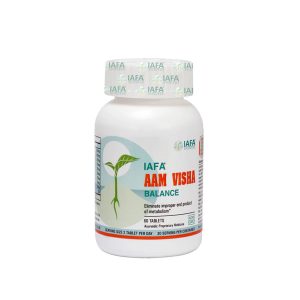
Aam Visha Balance Tablet
Frequently Asked Questions (FAQs)
Q1. What is Aam Visha Balance Tablet Used for?
Ans. Aam Visha Balance Tablet helps manage acidity, acid reflux, Ama accumulation, digestive irritation, and Pitta imbalance.
Q2. How does Aam Visha Balance Tablet help with Acidity?
Ans. It helps balance excess Pitta, reduce gastric heat, soothe acidity, and support healthy digestion.
Q3. What is Aam Visha in Ayurveda?
Ans. Aam Visha is a condition where undigested metabolic waste (Ama) becomes reactive and causes inflammation, heat, and digestive disturbances.
Q4. Is Aam Visha Balance Tablet Safe?
Ans. Yes, it contains traditionally purified Ayurvedic ingredients and is intended for use in recommended doses under professional guidance.
Q5. What are the Key Benefits of Aam Visha Balance Tablet?
Ans. It supports Pitta balance, reduces acidity, promotes Ama detoxification, calms internal heat, and improves digestive comfort.
References
- Ravindra Angadi, 1st edition, The Textbook of Bhaishajya Kalpana, Chaukhambha Prakashan, 2016.
- Sharangdhara Samhita, Madhyama Khanda, Chaukhamba Prakashan, Varanasi.
- Pal D, Sahu CK, Haldar A. Bhasma: The ancient Indian nanomedicine. J Adv Pharm Technol Res. 2014 Jan; 5 (1): 4- 12. doi: 10. 4103/ 2231-4040.126980. PMID: 2469- 6811; PMCID: PMC- 3960793.
- Sharma R, Bedarkar P, Timalsina D, Chaudhary A, Prajapati PK. Bhavana, an Ayurvedic Pharmaceutical Method and a Versatile Drug Delivery Platform to Prepare Potentiated Micro-Nano-Sized Drugs: Core Concept and Its Current Relevance. Bioinorg Chem Appl. 2022 Apr 29; 2022: 1685393. doi: 10. 1155/ 2022/ 1685393. Retraction in: Bioinorg Chem Appl. 2023 Dec 20; 2023: 983- 1784. doi: 10. 1155/ 2023/ 9831784. PMID: 3552- 9314; PMCID: PMC- 9076343.
- Kumar A, Nair AG, Reddy AV, Garg AN. Bhasmas: unique Ayurvedic metallic-herbal preparations, chemical characterization. Biol Trace Elem Res. 2006 Mar; 109 (3): 231- 54. doi: 10. 1385/ bter: 109: 3: 231. PMID: 1663- 2893.
- Arya, Raj. (2014). Characterization of Bio-Active Nanoparticles – Bhasma, an Indian Ayurvedic Drug. Indian Journal of Pharmaceutical Education and Research. 48. 61- 68. 10. 5530/ ijper. 48. 1. 10.
- Rastogi S, Pandey P. Aam assessment in the clinical practice of Ayurveda: Outlining the process and predicting the outcomes. J Ayurveda Integr Med. 2025 May- Jun; 16 (3): 101126. doi: 10. 1016/ j. jaim. 2025. 101126. Epub 2025 May 30. PMID: 40449364; PMCID: PMC- 12166776.
- Charka Samhita by Agnivesha, revised by Charaka and Dridhabala with Hindi commentary by Pt. Kashinath Pandey and Dr. Gorakhnath Chaturvedi, Sutra Sthana Part I, Chaukhamba Bharati Academy, Varanasi; Reprint Year, 2013.
- Sharma P, Yadlapati R. Pathophysiology and treatment options for gastroesophageal reflux disease: looking beyond acid. Ann N Y Acad Sci. 2021 Feb; 1486 (1): 3- 14. doi: 10. 1111/ nyas. 14501. Epub 2020 Oct 4. PMID: 3301- 5827; PMCID: PMC- 9792178.
- Ravte, Rohit & Dixit, Amit Kumar & Mitra, Achintya & Hazra, Jayram & Sharma, Loknath. (2015). EFFICACY OF KAPARDA BHASMA, A POPULAR AYURVEDIC DRUG IN THE MANAGEMENT OF AMLAPITTA (ACID PEPTIC SYNDROME) EUROPEAN JOURNAL OF PHARMACEUTICAL AND MEDICAL RESEARCH. European Journal of Pharmaceutical and Medical Research. 2. 394- 401.
- Hotamisligil GS. Inflammation and metabolic disorders. Nature. 2006 Dec 14; 444 (7121): 860- 7. doi: 10. 1038/ nature 05485. PMID: 1716- 7474.
- Leon LR, Helwig BG. Heat stroke: role of the systemic inflammatory response. J Appl Physiol (1985). 2010 Dec; 109 (6):1980- 8. doi: 10. 1152/ japplphysiol. 00301. 2010. Epub 2010 Jun 3. PMID: 20522730.
- Dhaliya R, Babu H. Ayurvedic visha hara (antitoxic) chikitsa in recurrent dyshidrotic eczema skin disease: A case report. J Ayurveda Integr Med. 2021 Jan- Mar; 12 (1): 156- 160. doi: 10. 1016/ j. jaim. 2020. 06. 010. Epub 2020 Aug 27. PMID: 3286- 3125; PMCID: PMC- 8039325.
- Leon LR, Helwig BG. Heat stroke: role of the systemic inflammatory response. J Appl Physiol (1985). 2010 Dec; 109 (6):1980- 8. doi: 10. 1152/ japplphysiol. 00301. 2010. Epub 2010 Jun 3. PMID: 20522730.
- Gano D, Appanna R, Santonicola A, De Bartolomeis F, Stellato C, Cianferoni A, Casolaro V, Iovino P. Food Allergy and Intolerance: A Narrative Review on Nutritional Concerns. Nutrients. 2021 May 13; 13 (5): 1638. doi: 10. 3390/ nu- 13051638. PMID: 3406- 8047; PMCID: PMC- 8152468.
- Singh, Divya & Mal, Nakhat & Kumar, Vinod & Sharma, Rajendra & Pareek, Purva. (2023). Scientific explanation of the mode of action of Kamadudha Rasa in Amlapitta with special reference to Acid Peptic Disorders: A Review. Journal of Ayurveda and Integrated Medical Sciences. 8. 99- 105. 10. 21760/ jaims. 8. 4. 17.
- Gupta A, Gupta P, Bajpai G. Tinospora cordifolia (Giloy): An insight into the multifarious pharmacological paradigms of a most promising medicinal ayurvedic herb. Heliyon. 2024 Feb 15; 10 (4): e26125. doi: 10. 1016/ j. heliyon. 2024. e26125. PMID: 38390130; PMCID: PMC- 10882059.
- Vidyashree, Vidyashree & Shankar, Gowda & S., Doddamani. (2017). Analytical assessment of Akika Pishti based on Ancient and Modern Parameters. Journal of Ayurveda and Integrated Medical Sciences (JAIMS). 2. 10. 2. 1760/ jaims. v2i3. 8215.
- Rathi, Bharat & Satpute, Megha. (2023). Pravala Bhasma formulations in Bhaishajya Ratnavali: Critical review. Journal of Indian System of Medicine. 11. 10. 4103/ jism. jism_4_23.
- Kaushik, Peeyush & Meena, Rani & Ahuja, & Dhyani, Akanksha & Bhatt, Dinesh & Goel, Anjali & Scholar, M, & Head (2016). International Journal of Ayurveda and Pharma Research STANDARD OPERATING PROCEDURE OF JAHAR MOHRA PISHTI: A POTENT CARDIO TONIC.
- Das, Subrata & Joshi, Alpana & Sharma, Vinamra & Bisht, Laxmi & Das, Neeladrisingha & Sharma, Niti & Shukla, Sunilkumar & Mehra, Deepika & Joshi, Kamal & Balkrishna, Achariya & Dhara, Santanu. (2020). Cellular internalization of Godanti Bhasma (anhydrous CaSO4) induces massive cytoplasmic reversible vacuolation and survival response of mammalian cells. 10. 1101/ 2020. 02. 01. 930594.
- Metia, Elina & Jadar, G. (2024). Therapeutic Approach of Mukta Pishti W.S.R to Gastrointestinal Diseases. International Journal of All Research Education & Scientific Methods. 12. 1508- 1513.
- Meena, Vandana & Bhushan, Shakti & Chaudhary, Anand. (2019). PHARMACEUTICAL VALIDATION & PROCESS CONCEPTUALISATION OF ANCIENT INDIAN CALCIUM PREPARATION: SHANKHA BHASMA. 10. 13040/ IJPSR. 0975-8232. 10 (10). 4724- 30.