

 213
213
 Share
Share



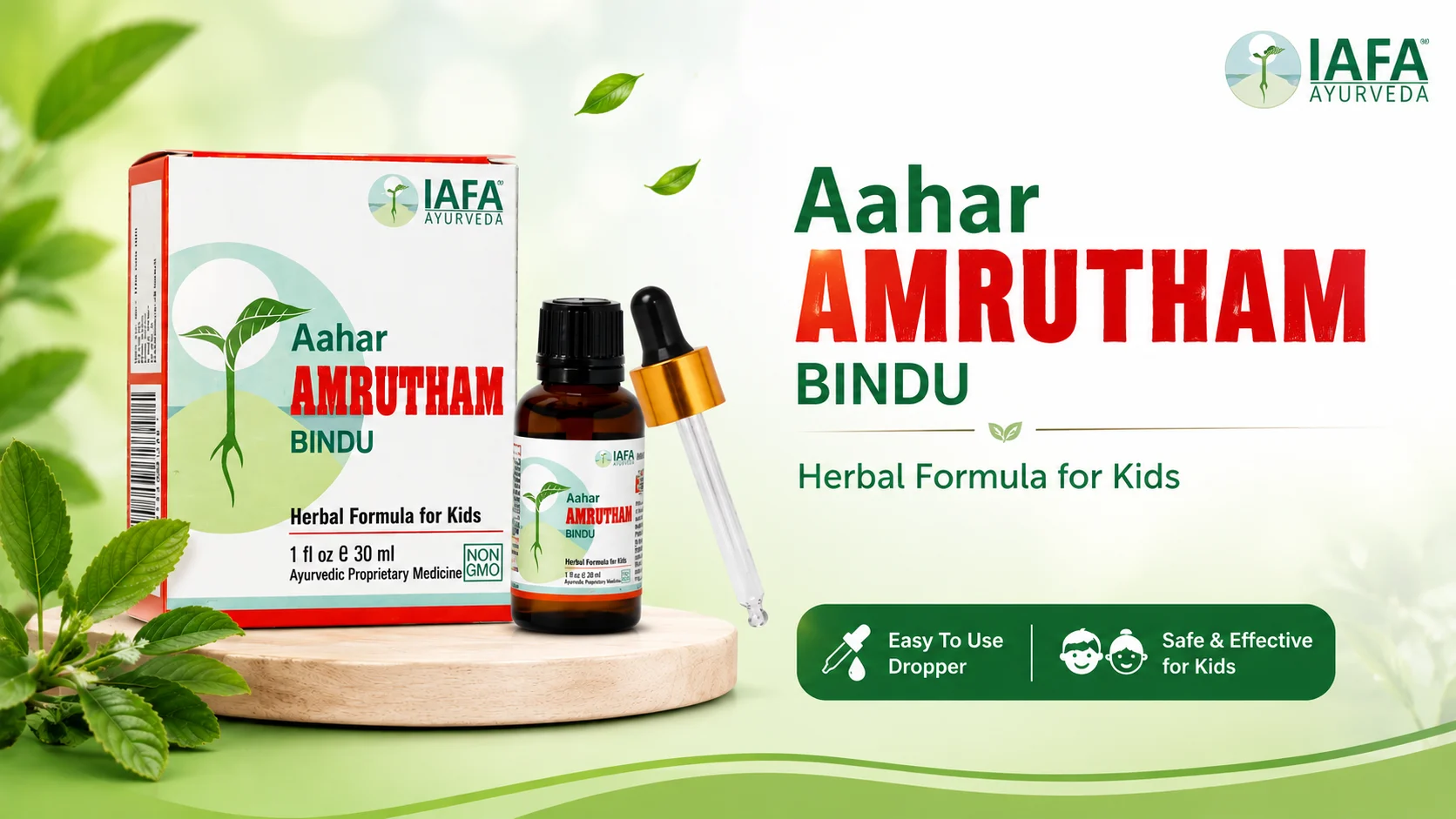
What is Aahar Amrutham Bindu?
Aahar Amrutham Bindu is not just a digestive drop, it is a foundation builder for a child’s health. Designed in a gentle Bindu (drop) form, it works at the most important level in children, i.e., how their body accepts, digests, and uses food.
Because the real issue is not what children eat – It’s how well their body can process and absorb it.
Instead of forcing digestion or giving temporary relief, Aahar Amrutham Bindu works by:
- Supporting natural appetite development
- Helping the gut function smoothly and comfortably
- Improving how nutrients are absorbed and utilized
- Reducing everyday issues like bloating, irregular stools, or poor digestion
Why Does It Matter?
A child who digests well:
- Eat better
- Feels better
- Grows better
And most importantly, develops a stronger internal foundation for health
It doesn’t just help your child eat more—it helps their body benefit more from what they eat.
“Because growth is not just about food, it’s about how well the body uses it.”
What are the Benefits of the “Bindu” Form for Children?[1-4]
Not just a dosage form but a thoughtful pediatric design rooted in Ayurvedic wisdom.
In pediatric Ayurveda (Kashyapa Samhita), children are considered:
- Sukumara (delicate in structure)
- Manda Agni (developing digestive capacity)
- Aparipakva Dhatu (immature metabolic system)
Because of this, they do not respond well to strong, bulky, or excessive dosing.
They require small, precise, and gentle interventions, given repeatedly, not forcefully.
Why is Bindu (Drop Form) Ideal?
The Bindu form is designed exactly for this purpose:
- Sukshma Matra (Micro-Dosing Precision)
Delivers a minimal yet effective quantity suited to a child’s capacity
- Mridu Kriya (Gentle Action)
Supports digestion without overwhelming the system
- Anukula Sevana (Easy Acceptance)
Drops are easy to administer-no resistance, no struggle
Why Does This Matters Clinically?
In children:
- Agni is unstable and easily disturbed
- The gut is sensitive and reactive
- Even a small excess can lead to Ama formation or imbalance
Heavy or strong formulations may:
- Overstimulate digestion
- Disturb the natural balance
- Reduce compliance (child refuses medicine)
What Bindu Form Achieves
- Provides just enough stimulation without excess
- Maintains digestive balance rather than forcing correction
- Allows consistent, repeated support for developing systems
Supporting the body without disturbing its natural rhythm
In children, the right amount matters more than the strong amount-Bindu form delivers exactly that.
What’s Actually Going Wrong in Children?
Understanding the root, not just the symptoms.[1,5]
When digestion is weak, the whole system becomes reactive; when digestion is balanced, the child becomes resilient.
Most childhood issues, whether related to digestion, immunity, or recurrent illnesses, are not isolated problems. They often originate from one central factor – an underdeveloped and unstable digestive system (Agni).
What Happens Inside a Child’s Body?
In children:
- Agni is still developing (Manda Agni) [3]
- The gut is functionally immature and sensitive
- Metabolic processes are not yet fully efficient
Because of this:[5]
1. Incomplete Digestion Begins
Food is not properly processed, which leads to the formation of Ama (metabolic residue).
2. Ama Starts Acting as an Internal Trigger
Ama doesn’t just stay in the gut, it:
- Circulates in the body
- Interferes with normal metabolism
- Makes tissues more reactive
3. Strotas (Body Channels) Get Affected
Especially:
- Anna Vaha Strotas – Digestion becomes irregular
- Rasa Vaha Strotas – Nutrient distribution becomes inefficient
- Udaka Vaha Strotas – Fluid balance and gut comfort get disturbed
4. Gut–Immune Connection Gets Disturbed
Modern understanding also shows:
- The gut plays a major role in immune development [6]
- Poor digestion leads to poor immune regulation
What Does This Lead To?
It doesn’t stay limited to digestion.
It starts showing as:
- Poor appetite or picky eating
- Bloating, gas, or abdominal discomfort
- Irregular stools (constipation or loose stools)
- Reduced nutrient absorption, which leads to suboptimal growth
- Low energy, irritability
And over time, the same imbalance can progress into:
- Frequent infections (reduced immunity)
- Food sensitivities and intolerance
- Allergic tendencies (skin, respiratory, gut)
- Recurrent minor illnesses that don’t fully resolve
In children, digestion is not just about food; it is the foundation of immunity, growth, and overall health.

Have A Health Issue?
Consult Online
- Dr. Sahil Gupta (B.A.M.S., M.H.A.)
Ayurvedic Allergy Specialist
CEO & Founder of IAFA®
Benefits of Aahar Amrutham Bindu – Herbal Foundation of Aahar Amrutham Bindu
Gentle by design. Functional by action. Aligned with a child’s developing physiology.
• Agni Support • Gut Stability • Nutrient Utilization
“In children, correction must be gentle, repeated, and physiological, and Aahar Amrutham Bindu formulation is built exactly on that principle.”
Why These Herbs?
Ayurveda emphasizes Mridu (gentle), Sukshma (subtle), and Anukula (adaptable) therapies in children. Modern science also confirms pediatric digestion is immature, enzyme-variable, and microbiome-evolving. Hence, therapy must:
✔ Support does not force
✔ Regulate, not override
1. Vacha (Acorus calamus) – Gentle Agni Initiator for Developing Digestion [7,8]
“Starts digestion- without overstimulating it.”
Ayurvedic Role:
In children with weak digestion, Vacha helps initiate the digestive process, making the system more responsive to food intake.
- Acts as Deepana (Agni stimulant) without causing heaviness
- Medhya effect helps coordination between the gut and higher centers (gut-brain axis)
- Vata-Kapha Shamana, which reduces sluggish digestion, gas, and poor appetite
- Useful in conditions of Mandagni and Arochaka (loss of appetite)
Modern Correlation:
Helps trigger the start of digestion in low-appetite children
- Contains β-asarone and other volatile oils
- Demonstrates prokinetic and digestive stimulant activity
- Influences gut motility and neural signaling pathways
2. Musta (Cyperus rotundus) – Stabilizer for Sensitive Pediatric Gut [9-11]
“Balances what is irregular, without disturbing what is normal.”
Ayurvedic Role:
Musta works as a regulator, not just a corrector, bringing the gut back to rhythm.
- Deepana-Pachana Dravya -improves digestion and metabolism
- Act as Grahi, so it absorbs excess fluid and stabilizes bowel movements
- Balances both Atisara (loose stools) and Vishama Agni (irregular digestion)
- Pacifies Pitta-Kapha, reducing inflammation and mucus
Modern Correlation:
Normalizes digestion when it is unstable or inconsistent
- Shows antidiarrheal, anti-inflammatory, and antimicrobial effects
- Helps regulate intestinal motility and secretion
- Supports restoration of gut functional balance
3. Parpata (Fumaria indica) -Light Metabolic Support for Young Systems [12-14]
“Keeps metabolism clean without harsh detox.”
Ayurvedic Role:
Acts as a metabolic corrector, ensuring that what is digested is also properly processed and circulated.
- Pittahara and Raktaprasadana clear internal heat and metabolic impurities
- Supports Ama Pachana at a subtle level
- Maintains balance in Rasa and Rakta Dhatu
Modern Correlation:
Improves internal processing and reduces metabolic overload.
- Exhibits hepatoprotective and detox-supportive properties
- Supports liver enzyme activity and metabolic clearance pathways
- Helps reduce metabolic stress and toxin buildup
4. Bilva (Aegle marmelos) – Protective Support for Immature Bowel Function [15-17]
“Gives stability where the gut is not yet stable.”
Ayurvedic Role:
Bilva strengthens the structural and functional stability of the intestine, especially in children prone to loose stools.
- Grahi (absorbent) thus reduces excess bowel movement frequency
- Deepana Dravya helps improve digestive strength
- Useful in Atisara, Grahani, and weak intestinal function
- Stabilizes Apana Vayu, improving bowel control
Modern Correlation:
Provides firmness and control in unstable bowel patterns
- Demonstrates antidiarrheal, antimicrobial, and mucosal protective effects
- Supports intestinal barrier function
- Help regulate gut secretion and absorption
5. Dadima (Punica granatum) – Natural Appetite Builder and Gut Supporter [18-20]
“Encourages eating and ensures it benefits the body.”
Ayurvedic Role:
Dadima works at both levels:
✔ Improves desire to eat
✔ Improves ability to utilize food
- Act as Deepana and Grahi Dravya, thus improving appetite and digestion
- Balya – supports strength and nourishment
- Enhances Rasa Dhatu formation, improving overall nutrition
Modern Correlation:
Enhances appetite while improving nutrient absorption
- Rich in polyphenols (punicalagins, ellagic acid)
- Supports gut microbiota and mucosal integrity
- Exhibits antioxidant and mild digestive support activity
6. Sariva (Hemidesmus indicus)- Soothing Balancer for Sensitive Systems [21-23]
“Maintains comfort while the system learns to balance.”
Ayurvedic Role:
Sariva ensures that while digestion is improved, the system does not become overheated or irritated.
- Pittahara and Raktaprasadana reduce internal irritation and heat
- Supports Dhatu balance and internal comfort
- Acts as a mild Anulomana and Rasayana-supportive herb
Modern Correlation:
Maintains softness, balance, and tolerance in the system
- Demonstrates anti-inflammatory, antioxidant, and immunomodulatory effects
- Helps maintain systemic equilibrium
- Supports mild detoxification pathways
This formulation works as a layered system:
“Each herb works softly, but together they build a digestive system that is stable, responsive, and ready to support healthy growth.”
- Initiates digestion → Vacha
- Regulates gut function → Musta, Bilva
- Supports metabolism → Parpata
- Enhances appetite and nourishment → Dadima
- Maintains balance and prevents irritation → Sariva
“Aahar Amrutham Bindu Works Not by forcing digestion, but by developing it, gently and consistently.”
How Aahar Amrutham Bindu Works As A System? [1,2,5,24]
“A stepwise correction of digestion, designed for a child’s developing physiology.”
Step-wise Uses and Benefits of Aahar Amrutham Bindu
LEVEL 1 – AGNI INITIATION (DEEPANA)
(• Vacha – β-asarone, volatile oils • Dadima – Polyphenols)
↑ Activates Jatharagni
↑ Improves appetite signaling
↑ Enhances digestive readiness
Initiates digestion in children with low appetite and weak Agni
LEVEL 2 – METABOLIC CORRECTION (PACHANA)
(• Musta – Sesquiterpenes • Parpata – Alkaloids, fumaric compounds)
↓ Incomplete digestion
↓ Ama (metabolic residue) formation
↑ Proper breakdown and processing of food
Convert food into usable nutrition instead of toxic residue
LEVEL 3 – SROTAS FUNCTIONAL ALIGNMENT
(• Parpata – Hepatoprotective compounds • Dadima – Antioxidant polyphenols)
Acts on:
• Anna Vaha Srotas (digestive pathway)
• Rasa Vaha Srotas (nutrient circulation)
↓ Srotorodha (channel disturbance)
↑ Nutrient absorption and distribution
Transform digestion from blockage to smooth flow
LEVEL 4 – GUT STABILIZATION & REGULATION
(• Musta – Anti-diarrheal actives • Bilva – Tannins, marmelosin)
↓ Irregular bowel movements
↓ Bloating and gut discomfort
↑ Stable intestinal motility and absorption
Brings predictability and balance to a sensitive pediatric gut
LEVEL 5 – MUCOSAL PROTECTION AND COMFORT
(• Bilva – Mucosal protective compounds • Sariva – Hemidesmin, saponins)
↑ Intestinal lining support
↓ Gut irritation and sensitivity
↑ Internal comfort
Protects the gut while digestion improves
LEVEL 6 – NUTRITIONAL UTILIZATION
(DHATU POSHANA)
(• Dadima – Punicalagins • Sariva – Antioxidant compounds)
↑ Rasa Dhatu quality
↑ Nutrient assimilation
↑ Energy and growth potential
Ensures food is not just digested but properly utilized
COMPLETE SYSTEM FLOW
How Does Aahar Amrutham Bindu Benefit?
“From weak digestion to stable growth, each level builds the next, gently and systematically.”
Mandagni (Weak Digestion)
↓
Deepana (Agni Activation)
↓
Pachana (Ama Reduction)
↓
Srotas Alignment (Improved Flow & Absorption)
↓
Gut Stabilization (Regular Function)
↓
Dhatu Poshana (Growth & Nourishment)
↓
Stable Digestion • Better Absorption • Healthier Growth
Uses and Benefits of Aahar Amrutham Bindu [1,5]
“Designed to support digestion, absorption, and gut stability in growing children.”
Aahar Amrutham Bindu is indicated in conditions where digestive immaturity, irregular gut function, and poor nutrient utilization form the underlying cause.
1. Appetite And Digestive Weakness (Mandagni)
When children don’t feel like eating or eat very little
- Poor appetite (Arochaka)
- Sluggish digestion
- Early satiety (feels full quickly)
Supports Agni activation and natural appetite development
2. Functional Digestive Disturbances
Common day-to-day gut issues in children
- Bloating, gas, abdominal discomfort
- Irregular digestion patterns
- Post-meal heaviness
Improves digestion without irritating the gut
3. Irregular Bowel Patterns (Gut Instability)
- Loose stools or a tendency for frequent stools
- Alternating bowel patterns
- Mild digestive-related diarrhea
Helps stabilize intestinal function and bowel consistency
4. Gut-Related Nutritional Deficiency States
When eating is adequate but absorption is poor
- Poor weight gain
- Weak assimilation of nutrients
- Low energy due to poor digestion
Enhances nutrient absorption and utilization (Dhatu Poshana)
5. Ama-Related Pediatric Conditions
Where incomplete digestion creates internal imbalance
- Recurrent minor digestive disturbances
- Coated tongue, foul smell, and poor digestion are signs
- Low metabolic clarity
Supports Pachana and reduces Ama formation
6. Gut–Immunity Linked Issues
When weak digestion starts affecting overall health
- Frequent minor infections
- Low resistance
- Food sensitivity tendency
Strengthens the gut foundation for better immune development
7. General Digestive Support During Growth Phase
- Children with sensitive digestion
- During dietary transitions (weaning, food changes)
- As a supportive tonic for digestive stability
Maintains balanced digestion during critical growth phases
8. Gut–Allergy Linked Sensitivity (Secondary Support)
When a digestive imbalance contributes to hypersensitivity in children
- Food-related sensitivities
- Mild skin reactivity (itching, rashes linked with digestion)
- Recurrent cold-cough tendency with poor digestion
- Gut-triggered allergic patterns
Addresses underlying digestive imbalance, which plays a key role in immune reactivity by improving digestion and reducing Ama; it helps lower internal triggers that can contribute to hypersensitivity and allergic tendencies in children. Acts as supportive care in gut-associated allergic tendencies, not intended as a primary anti-allergic intervention.
Clinical Uses of Aahar Amrutham Bindu
- Ideal for early-stage digestive correction in children
- Suitable for daily use in mild to moderate digestive imbalance
- Can be used for preventive gut support
- Works best with consistent administration (Bindu form advantage)
“Corrects digestion at the root so the child doesn’t just eat better but grows better.”
Pediatric (Aahar Amrutham Bindu) Vs Adult (Adult Digestive Formulations)
“Different body, different strategy-not just different dose.”
| Parameter | Aahar Amrutham Bindu (Children) | Adult Digestive Formulations (Aahara Amrutham Ras, etc.) |
| Physiological State | Developing Agni, a sensitive system | Mature Agni, stronger tolerance |
| Therapeutic Goal | Develop digestion | Correct or stimulate digestion |
| Dosage Strategy | Micro-dosing (Bindu) | Standard dose (tablet/syrup) |
| Action Intensity | Gentle, progressive | Moderate to strong |
| Gut Sensitivity Handling | High (designed for a delicate gut) | Moderate |
| Ama Management | Subtle and continuous | Direct and stronger |
| Absorption Pattern | Rapid, low-load absorption | Requires digestion and breakdown |
| Compliance | Easy (drops, no resistance) | Variable (tablets / syrups) |
| Safety Margin | Designed for high tolerance | Depending on the formulation |
Conventional Pediatric Digestives Vs Aahar Amrutham Bindu
“Not just relieving symptoms, building digestive capability.”
| Parameter | Conventional Pediatric Digestives | Aahar Amrutham Bindu |
| Primary Approach | Symptom relief (gas, acidity, appetite) | Functional correction (Agni, Ama, Strotas) |
| Action Pattern | Temporary improvement | Progressive system development |
| Focus Area | Single symptom | Multi-level digestive issues |
| Impact on Root Cause | Minimal | Addresses underlying digestive immaturity |
| Effect on Appetite | Stimulates temporarily | Builds natural hunger signaling |
| Gut Stability | Limited | Improves bowel regularity and balance |
| Nutrient Utilization | Not directly addressed | Enhances Dhatu Poshana |
| Immune Link | Not considered | Supports gut-immune connection |
| Suitability for Long-Term Use | Limited | Designed for regular use |
| Form Advantage | Syrup (often sugary, bulky dose) | Bindu (precise, light, efficient) |
Bindu Vs Syrup Vs Tablet
“In children, digestion is not corrected by force; it is developed with precision. That is the advantage of Bindu.”
| Parameter | Bindu (Drops) | Syrup | Tablet |
| Dose Precision | High (micro-dosing) | Moderate | Fixed |
| Digestive Load | Minimal | Moderate | Requires breakdown |
| Absorption Speed | Fast | Moderate | Slower |
| Suitability in Children | Excellent | Good | Poor (in small kids) |
| Compliance | Very high | Moderate | Low |
| System Impact | Gentle and controlled | Bulk-dependent | Stronger, less flexible |
Dosage and Administration
“Gentle micro-dosing designed according to the child’s developing digestive capacity.”
Recommended Dosage
| Age Group | Recommended Dose | Mode of Administration |
| Infants (0–1 Year) | 2–3 drops | With 10 ml lukewarm water, preferably on an empty stomach |
| Children (1–10 Years) | 5–10 drops | With 20 ml of water, preferably on an empty stomach |
| Children aged 10 to 14 Years | 1–2 ml | With 30 ml of water, preferably on an empty stomach |
Administration Guidance
Can also be administered with:
- Honey (where age-appropriate)
- Fresh juices
- Sugar syrup
- Or as directed by the physician
Best given:
- In the morning on an empty stomach
- Or before meals for a better digestive response
Dose may be adjusted depending on:
- Clinical response
- Age
- Digestive strength (Agni)
- Severity of symptoms
Important Usage Guidance
The Bindu form allows gentle, precise, and age-appropriate administration without overloading the child’s developing digestive system.
- Use under medical supervision in persistent or recurrent digestive disorders.
- Not intended as a substitute for emergency pediatric care
- Maintain appropriate Pathya (dietary discipline) for best results
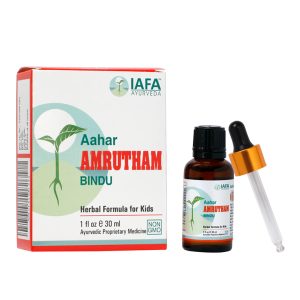
Aahar Amrutham Bindu
References
- Dash B. Kashyap Samhita or Vriddha Jivakiya Tantra. Varanasi: Chaukhamba Sanskrit Sansthan; 1996.
- Vaidya Jadavji Trikamji. Kashyap Samhita (with Vidyotini Hindi Commentary). Varanasi: Chaukhamba Sanskrit Series; 1994.
- Tiwari PV. Ayurveda Kaumarabhritya (Pediatrics). Varanasi: Chaukhamba Visvabharati; 2003.
- Ravindra Angadi, 1st edition, The Textbook of Bhaishajya Kalpana, Chaukhambha Prakashan, 2016.
- Charka Samhita by Agnivesha, revised by Charaka and Dridhabala with Hindi commentary by Pt. Kashinath Pandey and Dr. Gorakhnath Chaturvedi, Sutra Sthana Part I, Chaukhamba Bharati Academy, Varanasi; Reprint Year, 2013.
- Wopereis H, Oozeer R, Knipping K, Belzer C, Knol J. The first thousand days – intestinal microbiology of early life: establishing a symbiosis. Pediatr Allergy Immunol. 2014 Aug; 25 (5): 428- 38. doi: 10. 1111/ pai. 12232. Epub 2014 Jun 5. PMID: 2489- 9389.
- Joshi RK. Acorus calamus Linn.: phytoconstituents and bactericidal property. World J Microbiol Biotechnol. 2016 Oct; 32 (10): 164. doi: 10. 1007/ s11274- 016- 2124- 2. Epub 2016 Aug 25. PMID: 2756- 2598.
- Sharma V, Singh I, Chaudhary P. Acorus calamus (The Healing Plant): a review on its medicinal potential, micropropagation and conservation. Nat Prod Res. 2014; 28 (18): 1454- 66. doi: 10. 1080/ 14786419. 2014.915827. Epub 2014 May 13. PMID: 2482- 4923.
- Ali K, Ashraf A, Nath Biswas N. Analgesic, anti-inflammatory, and anti-diarrheal activities of ethanolic leaf extract of Typhonium trilobatum L. Schott. Asian Pac J Trop Biomed. 2012 Sep;2 (9): 722- 6. doi: 10. 1016/ S2221- 1691 (12) 60217- 2. PMID: 23570002; PMCID: PMC- 3609382.
- Hossain MS, Alam MB, Asadujjaman M, Zahan R, Islam MM, Mazumder ME, Haque ME. Antidiarrheal, Antioxidant, and Antimicrobial Activities of the Musa sapientum Seed. Avicenna J Med Biotechnol. 2011 Apr; 3 (2): 95- 105. PMID: 2340- 7989; PMCID: PMC- 3558179.
- Sivapalan SR.Medicinal uses and pharmacological activities of Cyperus rotundus Linn – A Review. Int J Sci Res Publ. 2013.
- Rao KS, Mishra SH.Antihepatotoxic activity of Fumaria indica. Fitoterapia. 1998.
- Rathi A, Srivastava AK, Shirwaikar A, Singh Rawat AK, Mehrotra S. Hepatoprotective potential of Fumaria indica Pugsley whole plant extracts, fractions, and an isolated alkaloid protopine. Phytomedicine. 2008 Jun;15 (6- 7): 470- 7. doi: 10. 1016/ j. phymed. 2007. 11. 010. Epub 2008 Mar 4. PMID: 1816- 4606.
- Rao CV, Verma AR, Gupta PK, Vijayakumar M. Anti-inflammatory and anti-nociceptive activities of Fumaria indica whole plant extracted in experimental animals. Acta Pharm. 2007 Dec; 57 (4): 491- 8. doi: 10. 2478/ v10007- 007- 0039- z. PMID: 18165192.
- Mujeeb F, Bajpai P, Pathak N. Phytochemical evaluation, antimicrobial activity, and determination of bioactive components from leaves of Aegle marmelos. Biomed Res Int. 2014; 2014: 497606. doi: 10. 1155/ 2014/ 497606. Epub 2014 May 11. PMID: 24900969; PMCID: PMC- 4037574.
- Brijesh S, Daswani P, Tetali P, Antia N, Birdi T. Studies on the antidiarrhoeal activity of Aegle marmelos unripe fruit: validating its traditional usage. BMC Complement Altern Med. 2009 Nov 23; 9: 47. doi: 10. 1186/ 1472- 6882- 9- 47. PMID: 1993- 0633; PMCID: PMC- 2788518.
- Singh P, Dutta SR, Guha D. Gastric mucosal protection by Aegle marmelos against gastric mucosal damage: role of enterochromaffin cell and serotonin. Saudi J Gastroenterol. 2015 Jan- Feb; 21 (1): 35- 42. doi: 10. 4103/ 1319- 3767. 151224. PMID: 2567- 2237; PMCID: PMC- 4355861.
- Jurenka JS. Therapeutic applications of pomegranate (Punica granatum L.): a review. Altern Med Rev. 2008 Jun;13 (2): 128- 44. PMID: 1859- 0349.
- Rizzo G, Pineda Chavez SE, Vandenkoornhuyse E, Cárdenas Rincón CL, Cento V, Garlatti V, Wozny M, Sammarco G, Di Claudio A, Meanti L, Elangovan S, Romano A, Roda G, Loy L, Dal Buono A, Gabbiadini R, Lovisa S, Rusconi R, Repici A, Armuzzi A, Vetrano S. Pomegranate Extract Affects Gut Biofilm Forming Bacteria and Promotes Intestinal Mucosal Healing Regulating the Crosstalk between Epithelial Cells and Intestinal Fibroblasts. Nutrients. 2023 Apr 5; 15 (7): 1771. doi: 10. 3390/ nu- 15071771. PMID: 37049615; PMCID: PMC- 10097402.
- Li H, Ruan J, Huang J, Yang D, Yu H, Wu Y, Zhang Y, Wang T. Pomegranate (Punica granatum L.) and Its Rich Ellagitannins as Potential Inhibitors in Ulcerative Colitis. Int J Mol Sci. 2023 Dec 16; 24 (24): 17538. doi: 10. 3390/ ijms- 24241- 7538. PMID: 3813- 9367; PMCID: PMC- 10744232.
- Galhena PB, Samarakoon SR, Thabrew MI, Weerasinghe GA, Thammitiyagodage MG, Ratnasooriya WD, Tennekoon KH. Anti-Inflammatory Activity Is a Possible Mechanism by Which the Polyherbal Formulation Comprised of Nigella sativa (Seeds), Hemidesmus indicus (Root), and Smilax glabra (Rhizome) Mediates Its Antihepatocarcinogenic Effects. Evid Based Complement Alternat Med. 2012; 2012: 108626. doi: 10. 1155/ 2012/ 108626. Epub 2012 Nov 13. PMID: 2324- 3426; PMCID: PMC- 3517268.
- Saravanan N, Nalini N. Antioxidant effect of Hemidesmus indicus on ethanol-induced hepatotoxicity in rats. J Med Food. 2007 Dec; 10 (4): 675-82. doi: 10. 1089/ jmf. 2006.110. PMID: 181- 58840.
- Atal CK, Sharma ML, Kaul A, Khajuria A. Immunomodulating agents of plant origin. I: Preliminary screening. J Ethnopharmacol. 1986 Nov;18 (2): 133- 41. doi: 10. 1016/ 0378- 8741 (86) 90025- 5. PMID: 3560991.
- Bramha Nand Tripathi, Sharangdhar Samhita Madhyam Khanda, 1st chapter, 1994.