

 81
81
 Share
Share



Introduction
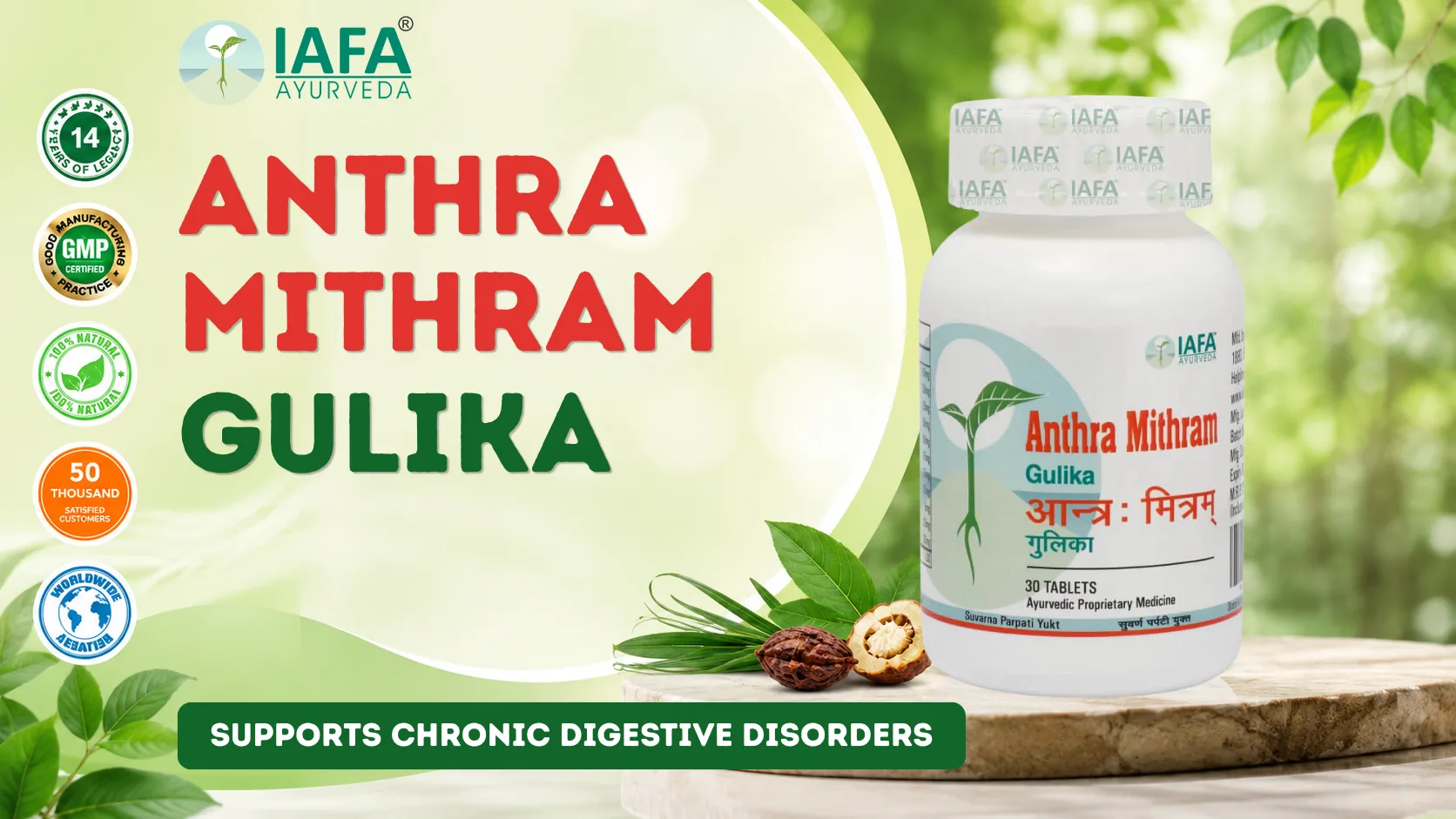
Anthra Mithram Gulika helps strengthen digestion, supports chronic digestive disorders, restores intestinal balance, and provides advanced Ayurvedic support for chronic digestive instability and Grahani dysfunction.
Things to Remember: Not every digestive disorder begins dramatically. In many cases, digestive imbalance develops gradually over time, with symptoms such as:
- Unpredictable appetite
- Irregular bowel movements
- A feeling of incomplete digestion
- Difficulty tolerating certain foods
- Alternating heaviness and weakness
- An increasingly sensitive and reactive intestine
Early attention to these signs may help support better digestive health and overall well-being.
Over time, the body may begin entering a state that Ayurveda describes as Grahani Dushti, a condition where digestion, absorption, intestinal coordination, and metabolic processing gradually lose balance.
Anthra Mithram Gulika is designed for this deeper level of digestive dysfunction. Inspired by classical Ayurvedic Parpati principles, this advanced herbo-mineral formulation combines carefully processed mineral preparations, Grahani-supportive compounds, and digestive regulators traditionally valued for:
- Grahani-associated disorders
- Chronic digestive weakness
- Intestinal instability
- Malabsorption tendency
- Irregular bowel patterns
- Disturbed Agni with intestinal sensitivity
- Post-meal heaviness and digestive fatigue
Rather than aggressively forcing digestion, the formulation is designed to support intestinal coordination, metabolic steadiness, and digestion stability gradually and physiologically.
Healthy digestion is not merely symptom-free digestion; it is the ability to digest, absorb, regulate, and tolerate food without instability.
What is “Grahani” in Ayurveda? [1-3]
Grahani in Ayurveda does not simply represent one anatomical structure. It represents the functional digestive system responsible for:
- Digestion
- Absorption
- Retention
- Metabolic transformation
- Intestinal coordination
Classical Ayurvedic texts describe Grahani as deeply dependent on the stability of Agni. When Agni remains balanced:
- Digestion becomes efficient
- Nutrient assimilation remains proper
- Bowel rhythm stays coordinated
- Metabolism functions smoothly
But when Agni becomes weak, irregular, or unstable:[4]
- Food processing becomes incomplete
- Ama begins accumulating
- Intestinal tolerance reduces
- Bowel function becomes inconsistent
- Nutrient assimilation declines
This may gradually appear as:
- Loose stools after meals
Alternating bowel patterns
- Intestinal heaviness
- Mucus-associated bowel disturbance
- Food intolerance tendency
- Post-meal fatigue
- Chronic digestive weakness
- Incomplete digestion
Modern understanding correlates with:[5-8]
- Intestinal dysregulation
- Altered gut motility
- Functional bowel disorders
- Malabsorption tendency
- Chronic gastrointestinal sensitivity
Grahani is not merely a bowel disturbance; it reflects instability within the entire digestive processing system.
Why Do Digestive Disorders Keep Returning or Become Chronic?
Many digestive disorders improve temporarily but repeatedly relapse because the underlying digestive coordination remains disturbed. In chronic intestinal imbalance:
- Agni loses consistency
- Bowel rhythm becomes unpredictable
- Food tolerance fluctuates
- Intestinal responsiveness weakens
- Metabolic processing becomes irregular
As a result, the individual may repeatedly experience:
- Loose stools
- Bloating
- Abdominal heaviness
- Fatigue after meals
- Irregular appetite
- Intestinal discomfort
- Digestive exhaustion
Ayurveda considers this a deeper Agni-Grahani dysfunction rather than an isolated symptom. That is why classical Grahani-supportive formulations focus not only on symptomatic relief but also on:
- Agni stabilization
- Grahani strengthening
- Ama reduction
- Intestinal regulation
- Digestive adaptability
- Post-digestive assimilation
The goal is not temporary suppression, but restoration of functional digestive steadiness.
Why are Parpati-Based Formulations Different? [9-13]
Parpati Kalpana represents one of Ayurveda’s most specialized pharmaceutical approaches for chronic digestive and Grahani-related disorders. Traditionally, Parpati preparations are preferred in conditions where:
- Digestion is weak yet reactive
- Absorption becomes inconsistent
- Intestinal sensitivity increases
- Bowel rhythm loses coordination
- Chronic digestive fatigue develops
Unlike bulky formulations that may burden sensitive digestion, Parpati preparations are designed for:
- Precision dosing
- Deep digestive support
- Gradual metabolic correction
- Better intestinal adaptability
- Sustained digestive regulation
Classical Ayurvedic texts particularly describe Parpati preparations in:
- Grahani
- Chronic Atisara
- Digestive weakness
- Intestinal instability
- Malabsorption-associated conditions
Because in chronic digestive disorders, the intestine often requires stabilization rather than excessive stimulation.
Parpati formulation is designed not to overpower digestion but to rebuild its functional strength progressively.

Have A Health Issue?
Consult Online
- Dr. Sahil Gupta (B.A.M.S., M.H.A.)
Ayurvedic Allergy Specialist
CEO & Founder of IAFA®
Why are Herbo–Mineral Combinations Used? [14-17]
Anthra Mithram Gulika is not built only on digestive herbs. It combines:
- Parpati preparations
- Pishti and Bhasma compounds
- Grahani-supportive formulations
- Digestive metabolic regulators
In Ayurveda, these preparations are not used in raw mineral form. They undergo classical pharmaceutical procedures such as:
- Shodhana (purification)
- Bhavana (triturating and potentiating)
- Marana and Pishti processing
- Controlled heat transformation
These methods are intended to:
- Improve compatibility
- Reduce unwanted reactivity
- Enhance therapeutic precision
- Support bio-assimilation in very small doses
Modern studies on properly prepared Ayurvedic mineral formulations suggest:
- Extremely fine particle characteristics
- Organo-mineral transformation
- Improved bioavailability patterns
- Controlled therapeutic delivery
This is why classical Ayurvedic mineral formulations are administered in carefully regulated milligram quantities rather than bulk doses.
The purpose is not heaviness but precision digestive regulation through highly refined classical preparations.
Herbo–Mineral Foundation of Anthra Mithram Gulika
Anthra Mithram Gulika combines classical Parpati preparations, digestive regulators, and mineral stabilizers traditionally valued in chronic Grahani and various GIT associated conditions.
| Ingredient | Quantity | Classical role in formulation | Contribution to various digestive issues |
| Praval Panchamrut Ras | 50 mg | Pitta-balancing mineral preparation traditionally used in Grahani and Amlapitta | Supports gastric soothing, digestive tolerance, and mucosal balance |
| Piyush Valli Ras | 50 mg | Classical digestive-support formulation used in chronic intestinal weakness | Helps improve digestive responsiveness and metabolic steadiness |
| Mukta Panchamrut Ras | 25 mg | Cooling mineral formulation traditionally valued in Pittaja for digestive disturbance | Supports gastric comfort and helps reduce reactive digestive irritation |
| Kutajghan Vati | 50 mg | Grahi and bowel-regulating classical preparation | Helps maintain bowel regularity and intestinal stability |
| Giloy Satva | 50 mg | Rasayana and Amapachaka preparation | Supports metabolic clarity, digestive recovery, and immune balance |
| Godanti Bhasma | 75 mg | Classical cooling mineral support | Help calm the heat-associated digestive sensitivity and inflammatory reactivity |
| Swarnamakshik Bhasma | 25 mg | Traditionally used for Agni support and metabolic regulation | Supports digestive transformation and post-digestive assimilation |
| Mukta Shukti Pishti | 25 mg | Natural calcium-rich Pishti preparation | Helps maintain acid balance and gastrointestinal comfort |
| Vijay Parpati | 5 mg | Specialized Parpati preparation for Grahani disorders | Supports intestinal coordination and chronic digestive regulation |
| Panchamrut Parpati | 20 mg | Classical Parpati formulation used in weakened digestion | Helps improve Agni consistency and bowel adaptability |
| Suvarna Parpati | 25 mg | Advanced Rasayana-oriented Parpati preparation | Supports various digestive issues and long-term Grahani stabilization |
1. Vijay Parpati – A Classical Digestive Stabilizer for Grahani Support [18-20]
Supports intestinal balance and digestive steadiness in chronic bowel irregularity.
Ayurvedic Perspective
In Ayurveda, Vijay Parpati is traditionally valued in conditions involving:
- Grahani imbalance
- Chronic digestive weakness
- Irregular bowel rhythm
- Impaired Agni
It is regarded as:
- Deepana
- Pachana supportive
- Grahi
- Agni stabilizing
It is used in conditions where:
- Digestion remains incomplete
- Bowel habits become inconsistent
- Intestinal tolerance weakens
- Recurrent loose stools persist
Modern Perspective
Classical Parpati preparations are traditionally associated with:
- Digestive regulation
- Intestinal functional balance
- Absorptive support
- Chronic gastrointestinal stability
Help support long-term digestive issues rather than temporary symptomatic suppression.
2. Suvarna Parpati – A Classical Parpati for Digestive Strength and Intestinal Recovery [21]
Supports chronic intestinal weakness and Grahani instability.
Ayurvedic Perspective
Suvarna Parpati is traditionally valued in conditions involving:
- Chronic Grahani disorders
- Weak digestive capacity
- Intestinal debility and fatigue
- Long-standing digestive instability
It is regarded as:
- Agni supportive
- Grahani stabilizing
- Rasayana
- Dhatu nourishing
Traditionally used where digestion becomes weak, inconsistent, and unable to maintain proper assimilation over time.
Modern Perspective
Traditionally processed Parpati preparations are associated with:
- Gastrointestinal functional support
- Improved digestive adaptability
- Metabolic regulation
Designed to support restoration of digestive stability rather than temporary symptom control.
3. Panchamrut Parpati – A Classical Parpati for Sensitive and Unstable Digestion[22]
Supports digestive balance where intestinal weakness and bowel irregularity coexist.
Ayurvedic Perspective
Panchamrut Parpati is traditionally valued in conditions involving:
- Grahani
- Mandagni
- Chronic bowel irregularity
- Digestive sensitivity and intestinal instability
It is regarded as:
- Agni supportive
- Grahi
- Pachana supportive
- Intestinal balance promoting
Traditionally used where digestion becomes inconsistent, bowel rhythm loses coordination, and proper food transformation remains incomplete.
Modern Perspective
Parpati-based preparations are traditionally associated with:
- Chronic gastrointestinal regulation
- Support in altered bowel tolerance
- Digestive coordination support
- Intestinal functional balance
Helps support long-term digestive adaptability in chronic intestinal instability.
4. Kutajghan Vati – The Intestinal Regulator for Disturbed Bowel Rhythm[23}
Supports bowel regulation and intestinal steadiness.
Ayurvedic Perspective
This formulation of Kutaj is one of Ayurveda’s most important formulations traditionally used in:
- Atisara
- Grahani
- Intestinal weakness
- Bowel irregularity
It helps:
- Stabilize bowel movement
- Reduce excessive intestinal looseness
- Support intestinal integrity
- Improve digestive coordination
Modern Perspective
It has demonstrated:
- Antimicrobial activity
- Antidiarrheal effects
- Gastrointestinal regulatory action
- Intestinal protective potential
5. Giloy Satva (Tinospora Cordifolia) – The Metabolic Regulator for Chronic Digestive Imbalance [24,25]
Supports digestive metabolism without excessive stimulation.
Ayurvedic Perspective
Giloy Satva is traditionally regarded as:
- Tridoshahara
- Rasayana
- Amapachaka
- Agni supportive
It is useful in:
- Chronic digestive fatigue
- Ama-associated intestinal disturbance
- Metabolic weakness
- Recurrent inflammatory digestive tendency
Modern Perspective
Tinospora cordifolia has demonstrated:
- Immunomodulatory activity
- Anti-inflammatory potential
- Oxidative stress reduction
- Metabolic regulatory effects
Classical Mineral Support for Gastric Balance, Digestive Tolerance, and Metabolic Stability
These traditionally processed Ayurvedic mineral preparations are added to support:
- Pitta balance
- Gastric regulation
- Mucosal protection
- Digestive transformation
- Intestinal tolerance in chronic reactive digestive states
Unlike aggressive acid-suppressive approaches, these preparations are traditionally used to help maintain digestive function while reducing excessive heat, irritation, and metabolic instability.
6. Praval Panchamrut Ras – Classical Cooling Support for Reactive Digestion[26]
Ayurvedic Perspective
Praval Panchamrut Ras is traditionally valued in:
- Amlapitta
- Pittaja digestive irritation
- Daha (burning sensation)
- Reactive gastric states
It is regarded as:
- Pittashamaka
- Sheetala
- Gastric soothing
- Mucosal supportive
Traditionally used where excessive digestive heat disturbs intestinal tolerance and gastric comfort.
Modern Perspective
Coral-derived mineral preparations are traditionally associated with:
- Gastric buffering support
- Reduction of acid-associated irritation
- Mucosal comfort
- Cooling support in reactive gastrointestinal states
- Supports digestive cooling
- Helps maintain mucosal balance
- Assists in reducing gastric irritation
7. Piyush Valli Ras – A Classical Support for Weak and Irregular Digestion
Ayurvedic Perspective
Piyush Valli Ras is traditionally used in:
- Mandagni
- Grahani
- Digestive weakness
- Irregular metabolism associated with chronic bowel instability
It is regarded as:
- Agni supportive
- Pachana supportive
- Grahani stabilizing
Useful where digestion becomes weak, inconsistent, and metabolically inefficient.
Modern Perspective
Traditionally processed herbo-mineral digestive formulations are associated with:
- Metabolic regulation
- Functional digestive support
- Improved digestive adaptability in chronic gastrointestinal weakness
- Supports digestive responsiveness
- Helps maintain metabolic steadiness
- Assists in chronic digestive fatigue
8. Mukta Panchamrut Ras – A Gentle Pitta-Balancing Digestive Support[27,28]
Ayurvedic Perspective
Mukta Panchamrut Ras is traditionally valued in:
- Pittaja digestive sensitivity
- Amlapitta
- Gastric irritation associated with heat aggravation
It is regarded as:
- Sheeta
- Pittahara
- Gastric calming
- Digestive tolerance supportive
Modern Perspective
Pearl-based Ayurvedic mineral preparations are traditionally associated with:
- Cooling physiological support
- Gastric soothing activity
- Reduction of heat-associated digestive reactivity
- Supports Pitta balance
- Helps maintain digestive tolerance
- Assists in reducing gastric sensitivity
9. Godanti Bhasma – A Classical Cooling Mineral Support for Heat-Associated Digestive Irritation[29-32]
Ayurvedic Perspective
Godanti Bhasma is traditionally used in:
- Pitta aggravation
- Daha
- Heat-associated inflammatory conditions
- Gastric irritation linked with excess Ushna
It is regarded as:
- Cooling
- Stabilizing
- Pittashamaka
Modern Perspective
Traditionally processed calcium sulfate preparations are associated with:
- Cooling support
- Reduction of inflammatory heat burden
- Gastrointestinal soothing support
- Helps reduce internal heat burden
- Supports gastrointestinal cooling
- Assists in calming inflammatory digestive sensitivity
10. Swarnamakshik Bhasma – A Classical Mineral Support For Digestive Transformation[33-37]
Ayurvedic Perspective
Swarnamakshik Bhasma is traditionally valued in:
- Mandagni
- Grahani
- Metabolic weakness
- Impaired digestive transformation
It is regarded as:
- Agni supportive
- Balya
- Rasayana supportive
- Dhatu-poshana supportive
Modern Perspective
Traditionally processed mineral preparations are associated with:
- Metabolic support
- Digestive efficiency
- Supportive role in post-digestive assimilation
11. Mukta Shukti Pishti – A Natural Gastric Buffering and Acid-Balancing Support[38,39]
Ayurvedic Perspective
Mukta Shukti Pishti is traditionally used in:
- Amlapitta
- Gastric burning
- Pittaja digestive irritation
- Acid-associated digestive discomfort
It is regarded as:
- Pittahara
- Sheeta
- Gastric soothing
- Acid-balancing supportive
Modern Perspective
Shell-derived calcium preparations are traditionally associated with:
- Gastric buffering support
- Acid regulation
- Mucosal protection
- Digestive comfort maintenance
- Supports balanced acid regulation
- Helps maintain gastric comfort
- Assists in digestive buffering support
Together, these classical preparations support digestive steadiness through cooling balance, mucosal support, metabolic regulation, and improved gastrointestinal tolerance.
How Anthra Mithram Gulika Works As A System?
LEVEL 1 – AGNI STABILIZATION
(• Vijay Parpati • Panchamrut Parpati)
↓ Digestive inconsistency
↓ Incomplete digestion
↑ Agni coordination
↑ Functional digestive balance
LEVEL 2 – GRAHANI SUPPORT
(• Kutajghan Vati • Suvarna Parpati)
↓ Bowel instability
↓ Intestinal weakness
↑ Grahani strength
↑ Bowel regulation
LEVEL 3 – AMA REDUCTION AND METABOLIC REGULATION
(• Giloy Satva • Swarnamakshik Bhasma)
↓ Ama-associated burden
↓ Metabolic irregularity
↑ Digestive processing
↑ Post-digestive assimilation
LEVEL 4 – INTESTINAL TOLERANCE AND MUCOSAL SUPPORT
(• Praval Panchamrut • Mukta Shukti • Godanti)
↓ Digestive reactivity
↓ Gastric irritation
↑ Mucosal comfort
↑ Intestinal adaptability
Therefore,
Disturbed Agni
↓
Incomplete Digestion
↓
Ama Formation
↓
Grahani Dysfunction
↓
Bowel Instability and Digestive Weakness
↓
Anthra Mithram Gulika Support
↓
• Agni Regulation • Grahani Support • Intestinal Coordination
↓
Improved Digestive Stability
Health Benefits and Uses of Anthra Mithram Gulika
Anthra Mithram Gulika is Ayurvedic Support for Chronic Digestive Disorders, Intestinal Instability, and Functional Gastrointestinal Imbalance.
Anthra Mithram Gulika is traditionally designed for conditions involving weakened digestion, Grahani dysfunction, chronic bowel irregularity, impaired assimilation, and intestinal sensitivity.
Grahani and Chronic Digestive Instability
Where digestion becomes inconsistent and intestinal regulation gradually weakens.
Traditionally indicated in:
- Grahani
- Sangrahani
- Grahani is associated with Mandagni
- Chronic intestinal weakness
Common presentations where we can use Anthra Mithram Gulika are:
- Frequent bowel irregularity
- Post-meal bowel urgency
- Incomplete digestion
- Weak assimilation
- Intestinal heaviness and fatigue
Modern clinical correlation may include:
- Irritable Bowel Syndrome (IBS)
- Functional bowel disorders
- Chronic intestinal dysregulation
- Malabsorption-associated digestive weakness
Chronic Loose Stools and Functional Diarrhea
For recurrent bowel looseness associated with weakened intestinal steadiness.
Traditionally used in:
- Atisara
- Jeerna Atisara
- Ama Atisara
- Grahani-associated loose stools
Common presentations where we can use Anthra Mithram Gulika are:
- Loose stools after meals
- Increased bowel frequency
- Incomplete evacuation
- Intestinal sensitivity
Support conditions involved:
- Functional diarrhea
- Chronic loose stool tendency
- Post-infectious bowel instability
- Mucus-associated bowel disturbance
Mandagni and Functional Indigestion
When digestion becomes weak, sluggish, and metabolically inefficient.
Traditionally indicated in:
- Mandagni
- Vishamagni
- Agnimandya
Common presentations where we can use Anthra Mithram Gulika are:
- Heaviness after meals
- Bloating and Fullness
- Variable appetite
- Digestive fatigue
- Sluggish digestion
Support conditions involved:
- Functional dyspepsia
- Chronic indigestion
- Sluggish gastrointestinal function
- Postprandial digestive discomfort
Ama-Associated Digestive Disorders
Incomplete digestion leads to metabolic heaviness and intestinal discomfort.
Traditionally used in:
- Amajeerna
- Sama Grahani
- Ama-associated digestive disturbance
Common presentations where we can use Anthra Mithram Gulika are:
- Coated tongue
- Sticky bowel movement
- Intestinal heaviness
- Food intolerance tendency
- Post-digestive discomfort
Support digestive states associated with:
- Gut-associated inflammatory tendency
- Altered food tolerance
- Chronic digestive sluggishness
- Metabolic digestive burden
Reactive and Sensitive Gastrointestinal States
For digestion that becomes reactive, sensitive, and difficult to stabilize.
Traditionally valued in:
- Sensitive digestion
- Reactive bowel tendency
- Intestinal irritability
- Gastric instability is associated with weak digestion
Common presentations where we can use Anthra Mithram Gulika are:
- Intestinal sensitivity after meals
- Digestive discomfort with certain foods
- Unstable bowel habits
- Recurrent gastric uneasiness
Support conditions associated with:
- Functional gastrointestinal disorders (FGIDs)
- Functional gastrointestinal sensitivity
- Chronic intestinal hypersensitivity
- Food-triggered digestive discomfort
Long-Standing Digestive Weakness and Post-Infective Recovery
Repeated digestive disturbance gradually weakens intestinal function.
Traditionally used in:
- Chronic digestive debility
- Recurrent intestinal disturbance
- Weak post-digestive assimilation
- Post-illness digestive weakness
Support conditions associated with:
- Recovery after chronic gastrointestinal infections
- Digestive weakness after recurrent diarrhea
- Long-term intestinal recovery support
Clinical Conditions Where Anthra Mithram Gulika May Be Used As Supportive Ayurvedic Management
Based on its classical Grahani indication, Parpati composition, bowel-regulating action, and digestive-supportive profile, Anthra Mithram Gulika may be considered in the following gastrointestinal conditions under Ayurvedic supervision:
- Irritable Bowel Syndrome (IBS)
- IBS-D (Diarrhea-predominant IBS)
- Functional Bowel Disorder (FBD)
- Functional Diarrhea
- Functional Dyspepsia
- Chronic Indigestion
- Chronic Loose Stool Tendency
- Post-Infectious IBS
- Intestinal Dysbiosis-associated digestive instability
- Malabsorption Syndrome
- Chronic Enteropathy-like digestive weakness
- Food Intolerance-associated bowel sensitivity
- Chronic Gastrointestinal Hypersensitivity
- Postprandial Distress Syndrome (PDS)
- Mucus-associated bowel disturbance
- Chronic Intestinal Irritability
- Sensitive Bowel States
- Non-infective chronic bowel irregularity
- Recurrent bowel urgency after meals
- Chronic digestive fatigue syndrome is associated with weak gut function
- Ulcerative Colitis (UC), especially in the remission or supportive phase
- Mild Inflammatory Bowel Disease (IBD) support
- Post-inflammatory bowel weakness
- Chronic colitis-associated digestive instability
- Non-specific chronic colitis
- Mucosal bowel irritation states
Why is Anthra Mithram Gulika Different?
| Other Digestive Support | Anthra Mithram Gulika |
| Symptom-focused | Grahani-focused |
| Temporary bowel control | Digestive system regulation |
| Works mainly at the symptom level | Supports Agni, Grahani, and assimilation |
| Short-term correction | Progressive digestive stabilization |
| General digestive support | Precision Parpati-based formulation |
Dosage and Administration
1 tablet twice a day with water or as directed by the physician.
Traditionally administered:
- After meals
- With appropriate Anupana depending on the condition
- Under professional supervision
Anthra Mithram Gulika
Important Guidance
- Use under qualified Ayurvedic supervision.
- Maintain appropriate Pathya-Apathya for best digestive outcomes.
- Avoid excessively heavy, incompatible, or difficult-to-digest foods during therapy.
- Long-standing digestive disorders require consistency and dietary discipline for optimal response.
“When digestion regains coordination, the body gradually regains stability.”
References
- Tripathi R, Charak Samhita, Volume 2, Chikitsa Sthana, Grahani Chikitsa Adhyaya, edited by Chaukhamba Sanskrit Pratishthan, Delhi, 2017; p 85.
- Acharya YT, editor. Sushruta Samhita of Sushruta, 3rd ed. Varanasi: Chaukhambha Surbharati Prakashana; 2010.
- Paradakara PH, editor. Ashtanga Hridaya of Vagabhatta, Nidana Sthana,6th ed (Reprint) Varanasi: Chaukhambha Surbharati Prakashana; 2010.
- Rastogi S, Pandey P. Aam assessment in the clinical practice of ayurveda: Outlining the process and predicting the outcomes. J Ayurveda Integr Med. 2025 May- Jun; 16 (3): 101126. doi: 10. 1016/ j. jaim. 2025. 101126. Epub 2025 May 30. PMID: 4044- 9364; PMCID: PMC- 12166776.
- Black CJ, Drossman DA, Talley NJ, Ruddy J, Ford AC. Functional gastrointestinal disorders: advances in understanding and management. Lancet. 2020 Nov 21; 396 (10263): 1664- 1674. doi: 10. 1016/ S0140-6736 (20) 32115-2. Epub 2020 Oct 10. PMID: 3304- 9221.
- Kovacic K. Current concepts in functional gastrointestinal disorders. Curr Opin Pediatr. 2015 Oct; 27 (5): 619- 24. doi: 10. 1097/ MOP. 0000000000000262. PMID: 2620- 8234.
- Tetali B, Suresh S. Management of irritable bowel syndrome: a narrative review. Transl Gastroenterol Hepatol. 2024 Mar 21; 9: 26. doi: 10. 21037/ tgh- 23- 96. PMID: 38716216; PMCID: PMC- 11074491.
- Kou R, Guo Y, Qin Z, Xu X, Liu Y, Wei W, Chen Y, Jian Z, Lan B. Systemic dysregulation of the gut microenvironment plays a pivotal role in the onset and progression of inflammatory bowel disease. Front Immunol. 2025 Sep 25; 16: 1661- 386. doi: 10. 3389/ fimmu. 2025. 1661- 386. PMID: 4108- 0582; PMCID: PMC- 12507907.
- Deepak, Kumar & Tiwari, Deepak & Singh, Sankalp & Tiwari, Saurabh. (2020). CONCEPT OF THE PARPATI KALPANA. 10. 20959/ wjpr- 202014- 19175.
- A textbook of Rasa Shastra, Dr. Bharati Umethia, Dr. Bharat Kalsariya, Chaukhambha Prakashan, Varanasi, pg. no. 107.
- Ayurvediya Rasa Shastra, Dr. Chandrabhushan Jha, Chaukhambha Surbharti Prakashan Varanasi, pg. no. 156.
- Ayurvediya Rasa Shastra, Dr. Chandrabhushan Jha, Chaukhambha Surbharti Prakashan Varanasi, pg. no. 157
- Sud, Sushant & Bandari, Srinivasulu. (2014). A SYSTEMATIC OVERVIEW OF –PARPATI KALPANAS. 2. 14- 23.
- Savrikar SS, Ravishankar B. Bhaishajya Kalpanaa – the Ayurvedic pharmaceutics – an overview. Afr J Tradit Complement Altern Med. 2010 Apr 3; 7 (3): 174- 84. doi: 10. 4314/ ajtcam. v7i3. 54773. PMID: 21461144; PMCID: PMC- 3025621.
- Pal D, Sahu CK, Haldar A. Bhasma: The ancient Indian nanomedicine. J Adv Pharm Technol Res. 2014 Jan; 5 (1): 4- 12. doi: 10. 4103/ 2231-4040. 126980. PMID: 24696811; PMCID: PMC- 3960793.
- Sharma R, Bedarkar P, Timalsina D, Chaudhary A, Prajapati PK. Bhavana, an Ayurvedic Pharmaceutical Method and a Versatile Drug Delivery Platform to Prepare Potentiated Micro-Nano-Sized Drugs: Core Concept and Its Current Relevance. Bioinorg Chem Appl. 2022 Apr 29; 2022: 1685393. doi: 10. 1155/ 2022/ 1685393. Retraction in: Bioinorg Chem Appl. 2023 Dec 20; 2023: 9831784. doi: 10. 1155/ 2023/ 9831784. PMID: 3552- 9314; PMCID: PMC- 9076343.
- Kumar A, Nair AG, Reddy AV, Garg AN. Bhasmas: unique ayurvedic metallic-herbal preparations, chemical characterization. Biol Trace Elem Res. 2006 Mar; 109 (3): 231- 54. doi: 10. 1385/ bter: 109: 3: 231. PMID: 1663- 2893.
- Mohammad, Nur & Chowdhury, Iqbal & Malhotra, Shagufta & Joshi, Prof. (2019). EVALUATE THE EFFICACY OF VIJAY PARPATI IN THE MANAGEMENT OF SAMGRAHANI W.S.R. TO IRRITABLE BOWEL SYNDROME – A CASE STUDY. International Ayurvedic Medical Journal. 7. 997- 1001.
- Shri Vagbhattacharya, Rasaratna Samuchchaya, Kulkarni D.A., Hindi commentary, Meharchand Laxmandas publication, New Delhi, 2006: 3/ 16
- Shri Vagbhattacharya, RasaratnaSamuchchaya, Kulkarni D.A., Hindi commentary, MeharchandLaxmandas publication, New Delhi, 2006: 5/ 28-29
- Dr. Sneha Dinesh Patel, Dr. Manoj Kumar Samantaray, Dr. Vikram S. Review article on Swarna Parpati with special reference to Aushadhi Gunadharma Shastra. J Ayurveda Integr Med Sci. 2020 Oct. 31 23]; 5 (05): 438- 40. Available from: https://jaims.in/jaims/article/view/1080
- Jadhav, Ashwini & pehekar, Dr.pranita. (2023). A CLINICAL STUDY OF THE ROLE OF PANCHAMRUT PARPATI IN GRAHANI VYADHI AND LIFESTYLE PRINCIPLE* Introduction. Journal of Oriental Studies. XCIV-VII: 2023. 78.
- Lather, Dr Amit & Gupta, Verruchi & Bansal, Parveen & Singh, Ramdev & Chaudhary, Amrendra. (2010). Pharmacological potential of ayurvedic formulation: Kutajghan vati-A review. J Adv Sci Res. 1. 41- 45.
- Sharma R, Amin H, Galib, Prajapati PK. Validation of standard manufacturing procedure of Guḍūcī sattva (aqueous extract of Tinospora cordifolia (Willd.) Miers) and tablets. Anc Sci Life. 2013 Jul; 33 (1): 27- 34. doi: 10. 4103/ 0257- 7941. 134564. PMID: 251- 61327; PMCID: PMC- 4140018.
- Choudhry N, Singh S, Siddiqui MB, Khatoon S. Impact of seasons and dioecy on therapeutic phytoconstituents of Tinospora cordifolia, a Rasayana drug. Biomed Res Int. 2014; 2014: 902138. doi: 10. 1155/ 2014/ 902138. Epub 2014 Aug 10. PMID: 25177701; PMCID: PMC- 4142535.
- Sharma, Usha & Rani, Sheenam. (2023). Review on Praval Panchamrita Rasa: A Natural Calcium Supplement. Scholars International Journal of Traditional and Complementary Medicine. 6. 134- 139. 10. 36348/ sijtcm. 2023. v06i09.001.
- Parmar, Jagruti & Upadhyay, Naiya & Patel, Manish & Gupta, Shivenarain. (2024). Ayurvedic management of systemic sclerosis – A case report. Journal of Ayurveda and Integrative Medicine. 15. 100956. 10. 1016/ j. jaim. 2024. 100956.
- Patel MV, Patel KB, Gupta SN. Effects of Ayurvedic treatment on forty-three patients of ulcerative colitis. Ayu. 2010 Oct; 31 (4): 478- 81. doi: 10. 4103/ 0974- 8520. 82046. PMID: 2204- 8543; PMCID: PMC- 3202252.
- Toxicological and Pharmacological Assessment of Godanti Bhasma, https://asianpubs.org/index.php/ajchem/article/view/9592
- Das SK, Joshi A, Bisht L, Goswami V, Faiz A, Dutt G, Sharma S. Godanti bhasma (anhydrous CaSO4) induces massive cytoplasmic vacuolation in mammalian cells: A model for phagocytosis assay. Methods. 2024 Oct; 230: 158- 168. doi: 10. 1016/ j. ymeth. 2024. 08. 006. Epub 2024 Aug 30. PMID: 3921- 6714.
- Singh SK, Rajoria K, Sharma S, Godatwar PK, Sharma S, Kotecha M, Agrawal SK, Sharma RP, Yadav S, Joshi R. An observational study on acceptability, palatability, and safety of Ayurveda immunity booster kit for the prevention of COVID-19 in frontline workers in Jaipur, India. Ayu. 2021 Jul-Sep; 42 (3): 111- 117. doi: 10. 4103/ ayu. Ayu 16 22. Epub 2023 Apr 12. PMID: 3730- 3860; PMCID: PMC102- 51284.
- Sharma, K &, Arun, Sharma, & Yadav, Yadevendra. (2020). UPDATED OVERVIEW ON GODANTI BHASMA (AN AYURVEDIC FORMULATION OF GYPSUM). 07. 16- 26.
- Gupta RK, Lakshmi V, Mahapatra S, Jha CB. Therapeutic uses of Swarnamakshika Bhasma (A Critical Review). Ayu. 2010 Jan; 31 (1): 106- 10. doi: 10. 4103/ 0974- 8520. 68191. PMID: 22131694; PMCID: PMC- 3215311.
- Savalgi PB, Patgiri B, Thakkar JH, Ravishankar B, Gupta VB. Evaluation of subchronic genotoxic potential of Swarna Makshika Bhasma. Ayu. 2012 Jul; 33 (3): 418- 22. doi: 10. 4103/ 0974- 8520. 108858. PMID: 23723652; PMCID: PMC- 3665102.
- Mohaptra S, Jha CB. Physicochemical characterization of Ayurvedic bhasma (Swarna makshika bhasma): An approach to standardization. Int J Ayurveda Res. 2010 Apr; 1 (2): 82- 6. doi: 10. 4103/ 0974- 7788. 64409. PMID: 2081- 4520; PMCID: PMC- 2924988.
- Pathiraja PMYS, Ranatunga YMMK, Herapathdeniya SKMK, Gunawardena SHP. Swarna Makshika Bhasma preparation using an alternative heating method to the traditional Varaha Puta. J Ayurveda Integr Med. 2020 Jul- Sep; 11 (3): 206- 212. doi: 10. 1016/ j. jaim. 2018. 02. 136. Epub 2019 Apr 2. PMID: 30952470; PMCID: PMC- 7527817.
- Mohapatra S, Jha CB. Evaluation of the effect of conventionally prepared Swarna Makshika Bhasma on different biochemical parameters in experimental animals. J Ayurveda Integr Med. 2011 Oct; 2 (4): 187- 91. doi: 10. 4103/ 0975- 9476. 90773. PMID: 22253508; PMCID: PMC 3255449.
- Sreejith R Dr; From 5th World Ayurveda Congress 2012, Bhopal, Madhya Pradesh, India. 7- 10 Dec 2012. PA01.62. Mukta-sukti bhasma; nectar for acid peptic disorders, w.s.r to its anti-ulcer activity – an experimental study. Anc Sci Life. 2012 Dec; 32 (Suppl 1): S112. PMCID: PMC- 3800866.
- Chauhan O, Godhwani JL, Khanna NK, Pendse VK. Anti-inflammatory activity of Muktashukti bhasma. Indian J Exp Biol. 1998 Oct; 36 (10): 985- 9. PMID: 1035- 6960.