

 1250
1250
 Share
Share



Abstract
Background: Pediatric food intolerance often presents as a multisystem disorder affecting the gastrointestinal tract, skin, and respiratory system, corresponding clinically to the concept of Allergic March. Ayurveda explains this condition as Aahar Asatmyata associated with Grahani Roga, Vicharchika, and Vata-Kaphaja Pratishyaya arising from Agnimandya and Ama formation.
Objective: To evaluate the clinical efficacy of an Ayurvedic treatment protocol in a child suffering from food intolerance with gastrointestinal, i.e., gluten sensitivity, cutaneous, i.e., atopic dermatitis, and nasal allergy.
Materials and Methods: A 4-year-old female child presented on 05/10/2021 with constipation, abdominal pain, gluten intolerance, skin itching, and behavioral changes at IAFA. She was treated with a combination of external and internal Ayurvedic medicines, dietary regulation (Pathya-Apathya), and lifestyle modification.
Results: The patient showed complete relief from constipation, marked reduction in abdominal pain, and approximately 30% improvement in skin lesions within three months.
Conclusion: Individualized Ayurvedic management focusing on Nidana Parivarjana, Agni Deepana, Ama Pachana, and Tridosha Shamana demonstrated significant clinical improvement in pediatric food intolerance with multisystem allergic involvement.
Introduction
Today, food intolerance and food-related allergic disorders in children are emerging as major public health concerns worldwide. The rising prevalence of gastrointestinal disturbances, atopic dermatitis, allergic rhinitis, and asthma in early childhood has led to the recognition of a progressive clinical phenomenon termed the “Allergic March.”
This concept describes the natural history in which food allergy and eczema in infancy frequently precede the later development of respiratory allergic diseases such as allergic rhinitis and asthma. Current epidemiological studies indicate that early gastrointestinal and skin hypersensitivity are significantly more likely to develop multisystem allergic disorders later in life.
As per recent studies, pediatric food intolerance is no longer considered a localized gut pathology. It is now understood as a complex disorder involving the gut-immune-brain axis. In genetically susceptible children, exposure to dietary antigens such as gluten, cow’s milk proteins, and other food components leads to impaired intestinal barrier function, altered gut microbiota composition, and dysregulated immune responses.
This process results in chronic low-grade inflammation, immune sensitization, and abnormal T-cell responses, which result clinically as constipation or diarrhea, abdominal pain, eczema, nasal congestion, and behavioral disturbances. Several recent studies have demonstrated that children with food hypersensitivity exhibit increased intestinal permeability and immune activation, supporting the systemic nature of this condition.
In Ayurveda, these clinical features are described under Aahar Asatmyata, meaning food incompatibility or intolerance. According to classical texts, repeated intake of Viruddha Bhojana, i.e., incompatible food combinations, excessive intake of heavy, unwholesome, or unsuitable foods, and improper dietary habits impair Jatharagni, i.e., digestive fire.
This leads to the formation of Ama, i.e., undigested, toxic metabolic products that circulate throughout the body and obstruct various Strotas (micro-channels). When Ama associates with vitiated Doshas, particularly Kapha and Vata, it gives rise to multisystem manifestations such as Grahani Roga (chronic digestive dysfunction), Vicharchika (atopic dermatitis), and Vata-Kaphaja Pratishyaya (nasal allergy).
Ayurveda further explains that childhood is predominantly a Kapha-dominant period of life, making children more susceptible to disorders characterized by heaviness, stickiness, hypersensitivity, and immune dysregulation. The clinical progression of eczema to allergic rhinitis and asthma described in modern medicine closely parallels the Ayurvedic description of progressive Strotodushti (channel dysfunction) involving Annavaha, Rasavaha, and Pranavaha Strotas. Thus, pediatric intolerance is not an isolated gastrointestinal disorder, but a systemic disease process rooted in digestive failure and metabolic toxicity.
Modern therapeutic approaches largely work under the use of elimination diets, symptomatic medication, and immune modulation, which often provide incomplete relief and do not address the underlying digestive dysfunction. On the other hand, Ayurveda offers a root-cause-oriented approach which focuses on Nidana Parivarjana (elimination of causative factors), Agni Deepana (restoration of digestive fire), Ama Pachana (detoxification), and Dosha Shamana (systemic balance). This integrated approach has the potential not only to alleviate existing symptoms but also to interrupt the progression of the allergic march.
The present case study is the Ayurvedic management of pediatric food intolerance presenting with gastrointestinal, cutaneous, and nasal manifestations, demonstrating how classical Ayurvedic principles can be effectively applied in such conditions.
Case Presentation
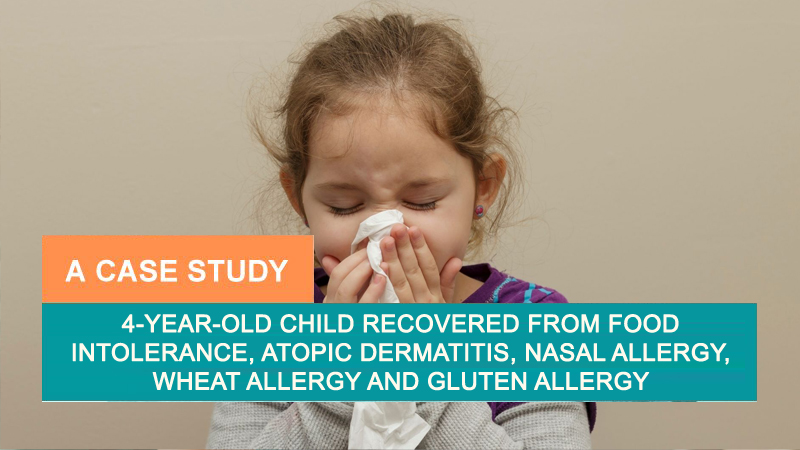
This case documents a four-year-old female child diagnosed with pediatric food intolerance with multisystem allergic manifestations involving the gastrointestinal tract, skin, and upper respiratory system.
1) Patient Details
Age/Sex- 4 years/Female
Date of First Consultation – 05th October 2021
2) Chief Complaints
At the time of presentation, the patient had the following complaints:
| Symptom | Duration |
| Constipation associated with abdominal pain | 9 months |
| Wheat and gluten intolerance (already on gluten-free diet) | Ongoing |
| Skin itching with a prickling sensation, mainly over the legs | 5 months |
| Behavioral changes | 2 months |
3) Past History
The patient had the following relevant past medical history:
- Exclusively breastfed up to the age of 6 months
- History of Celiac Disease for the last 1 year
- Positive family history of allergic disorders
- An episode of viral fever in November 2020
- Elevated tissue transglutaminase (TTG) level, i.e., 112
4) Diagnosis
Based on clinical evaluation, history, and dietary correlation, the final diagnosis was made as:
- Aahar Asatmyata (Food Intolerance)
- Grahani Roga (Wheat and Gluten Allergy)
- Vicharchika (Atopic Dermatitis)
- Vata-Kaphaja Pratishyaya (Nasal Allergy)
Materials and Methods
1) Intervention Protocol and Monitoring
The patient was managed at the Institute of Applied Food Allergy (IAFA) using an Ayurvedic protocol aimed at correcting digestive impairment, reducing food hypersensitivity, improving immune tolerance, and stopping the progression of multisystem allergic manifestations. The intervention began on 05/10/2021 with subsequent follow-ups on 25/11/2021 and 12/01/2022. At each visit, clinical evaluation was carried out based on gastrointestinal symptoms, cutaneous manifestations, nasal allergy features, and overall well-being.
2) Ayurvedic Treatment Approach
The condition was approached as Aahar Asatmyata associated with Grahani Roga, Vicharchika, and Vata-Kaphaja Pratishyaya. The therapeutic principles included:
- Nidana Parivarjana, i.e., elimination of causative food allergens, especially wheat and gluten
- Agni Deepana and Ama Pachana, i.e., restoration of digestive fire and removal of metabolic toxins
- Tridosha Shamana, i.e., pacification of vitiated Kapha, Vata, and Pitta
- Srotas Shodhana, i.e., regulation of Annavaha, Rasavaha, and Pranavaha Strotas
- Balya and Rasayana Chikitsa for strengthening immunity and preventing relapses
3) Treatment Protocol at Different Follow-ups
Table 1. Treatment Protocol-First Visit (05/10/2021)
| Therapy | Formulation | Dose | Frequency | Route |
| External | Pratimarsha Nasya by Nasa Yoga Ghrutam | 2-4 drops in both nostrils and navel | Morning and Bedtime | Nasal |
| External | IAFA E-5 Cell Repair Oil | 3-5 ml local application | Thrice daily | Topical |
| Internal | Aahar Amrutham Ras | 5 ml of water | Twice daily before meals | Oral |
| Internal | IAFA Skin Detox Drops | 1 ml with 20 ml of water | Thrice daily after meals | Oral |
| Internal | Anthram Mithram Gulika | 1 tablet | Once daily after a meal | Oral |
| Internal | Kutaz Ghanvati | ½ tablet | Twice daily after meals | Oral |
Table 2. Treatment Protocol-Follow-up Visit (25/11/2021)
| Therapy | Formulation | Dose | Frequency |
| External | Pratimarsha Nasya- Nasa Yoga Ghrutam | 2-4 drops | Morning and Bedtime |
| External | IAFA E-5 Cell Repair Oil | 3-5 ml | Thrice daily |
| Internal | Total Care 3X Ras | 10 ml with water | Once daily (morning, empty stomach) |
| Internal | Aahar Amrutham Ras | 10 ml with water | Once daily (bedtime) |
| Internal | IAFA Skin Detox Drops | 1 ml with 20 ml of water | Thrice daily |
| Internal | Anthram Mithram Gulika | 1 tablet | Once daily |
| Internal | Kutaz Ghanvati | ½ tablet | Twice daily |
Table 3. Treatment Protocol -Follow-up Visit (12/01/2022)
The same treatment regimen as 25/11/2021 was continued.
Table 4. Ayurvedic Treatment Phases, Objectives, Clinical Outcomes, and Mode of Action
| Phase | Ayurvedic Objective | Clinical Focus | Outcome | Mode of Action |
| I | Nidana Parivarjana | Elimination of wheat and gluten | Prevention of recurrent symptoms | Removal of food antigens |
| II | Agni Deepana, Ama Pachana | Correction of digestion | Reduction in constipation and abdominal pain | Detoxification and gut barrier restoration |
| III | Strotas Shodhana | Gut-skin-nasal axis correction | Improvement in skin itching and nasal symptoms | Immune modulation |
| IV | Tridosha Shamana | Multisystem balance | Reduction in allergic hypersensitivity | Regulation of inflammatory mediators |
| V | Rasayana and Balya | Prevention of relapse | Sustained symptom control | Immune strengthening |
Table 5. Monitoring Parameters
| Parameter | Method |
| Constipation and abdominal pain | Parent-reported |
| Skin itching and lesions | Visual examination |
| Nasal allergy symptoms | Symptom reporting |
| Dietary compliance | Dietary history |
| Overall well-being | Clinical assessment |
4) Dietary and Lifestyle Modification (Pathya-Apathya)
Pathya (Do’s)
- Lactose-free milk
- Rice water
- Old rice, buckwheat, ragi, millets, gluten-free oats
- Fennel, cumin, curry leaves
- Fruits like pomegranate, banana, mango, kiwi, bael, apple
- Green food once daily
Apathya (Don’ts)
- Wheat and gluten-containing grains
- Dairy products
- High-fat, spicy, and fermented foods
- Packaged foods, artificial additives
- Eggplant, capsicum, spinach, mushrooms
- Meat, seafood
- Incompatible foods like milk with salt, milk with fish, etc.
Results
1) Overall Clinical Outcomes
The patient was assessed at baseline on 05/10/2021 and subsequently followed up on 25/11/2021 and 12/01/2022. After initiation of Ayurvedic therapy along with strict dietary regulation, the child exhibited progressive clinical improvement. By the first follow-up, constipation had completely resolved, abdominal pain was markedly reduced, and skin itching had decreased by approximately 30%.
Continued therapy until the second follow-up resulted in sustained relief of gastrointestinal complaints, further reduction in cutaneous symptoms, improved food tolerance under dietary restriction, and better overall behavior and well-being. No adverse reactions to the prescribed medicines were reported during the entire treatment period.
Table 6. Symptom-wise Clinical Outcomes
| Symptom | Baseline (05/10/2021) | Follow-up 1 (25/11/2021) | Follow-up 2 (12/01/2022) |
| Constipation | Present with abdominal pain | Absent | Absent |
| Abdominal pain | Persistent | Reduced | Minimal |
| Skin itching (legs) | Severe itching with prickling | Approximately 30% improvement | Further improvement |
| Wheat/ gluten intolerance | On a gluten-free diet with symptoms | Improved tolerance with avoidance | Stable with dietary restriction |
| Behavioral changes | Present | Improved | Improved |
| Overall well-being | Disturbed | Better | Stable and improved |
2) Gastrointestinal Outcome Assessment
Gastrointestinal symptoms showed the most prominent improvement. Constipation, which had been present for nine months, was completely resolved after initiation of therapy. Abdominal pain and digestive discomfort steadily declined, and the child demonstrated improved tolerance to permitted foods. These changes correlated with the Agni Deepana, Ama Pachana therapy, and strict Pathya adherence, highlighting the role of digestive correction in the management of pediatric food intolerance.
Table 7. Gastrointestinal Symptom Improvement
| Parameter | Baseline | Follow-up 1 | Follow-up 2 |
| Constipation | Present | Absent | Absent |
| Abdominal pain | Present | Reduced | Minimal |
| Digestive tolerance | Poor | Improved | Stable |
| Food-related GI reactions | Frequent | Occasional with avoidance | Absent with compliance |
Discussion
This case has the classical presentation of pediatric food intolerance as a multisystem disorder involving the gastrointestinal tract, skin, and upper respiratory system. The coexistence of chronic constipation, abdominal pain, atopic dermatitis, and nasal allergy in this child reflects the modern concept of the Allergic March and closely parallels the Ayurvedic description of Aahar Asatmyata progressing into Grahani Roga, Vicharchika, and Vata-Kaphaja Pratishyaya.
The clinical improvement achieved through a digestion-centred Ayurvedic approach supports the hypothesis that early correction of digestive and metabolic dysfunction can modify disease progression rather than merely suppressing symptoms.
1) Pathophysiological Understanding
From the modern point of view, food intolerance in children is associated with impaired intestinal barrier integrity, dysbiosis, and disturbed immune responses to dietary antigens such as gluten and dairy proteins. These mechanisms result in chronic mucosal inflammation, immune sensitization, and systemic cytokine activation, producing gastrointestinal dysfunction, eczema, and allergic rhinitis.
As per Ayurveda, this condition is represented as Aahar Asatmyata, arising from repeated intake of incompatible or unsuitable foods, i.e., Viruddha Bhojana, that weaken Jatharagni. Impaired digestion results in the formation of Ama, which circulates and obstructs Annavaha, Rasavaha, and Pranavaha Strotas, giving rise to Grahani, Vicharchika, and Pratishyaya, respectively. Childhood, being a Kapha-dominant period, further results in hypersensitivity and mucosal pathology. Thus, the disorder represents a systemic metabolic-immune derangement rather than an isolated gastrointestinal disease.
2) Phase-wise Therapeutic Understanding
The management strategy was categorized as:-
Phase I – Nidana Parivarjana: Complete elimination of wheat, gluten, and incompatible foods that results in continuous antigenic stimulation.
Phase II – Agni Deepana and Ama Pachana: Ayurvedic formulations restored digestive capacity, leading to early resolution of constipation and abdominal pain.
Phase III – Strotas Shodhana: Skin detoxification and nasal therapy corrected gut-skin-nasal axis involvement.
Phase IV – Tridosha Shamana: Systemic dosha pacification reduced hypersensitivity manifestations.
Phase V – Rasayana and Balya: Strengthening of immunity and metabolic stability prevented relapses and ensured sustained symptom control.
This phased correction explains the gradual, sustained improvement observed clinically.
3) Pharmacological Correlation of Prescribed Ayurvedic Formulations
| Formulation | Key Herbs | Ayurvedic Karma | Mode of Action (Modern Correlation) |
| Aahar Amrutham Ras | Choti Dudhi, Nirgundi, Bilva, Bhoomi Amla, Punarnava | Agni Deepana, Ama Pachana, Grahi | Improves digestive enzyme activity, reduces gut inflammation, and restores intestinal permeability |
| IAFA Skin Detox Drops | Vasa, Manjistha, Devadaru, Khadira, Amrita, Aragwadha, Karanja, Patola | Twak Shodhana, Rakta Prasadana, Tridosha Shamana | Anti-inflammatory, antioxidant, immune modulation, and reduces allergic skin reactions. |
| Anthram Mithram Gulika | Praval Panchamrit, Mukta Pishti, Giloy Satva, Godanti Bhasma, Vijaya Parpati, Suvarana Parpati | Grahani Balya, Pitta Shamana | Gastroprotective, mucosal healing, modulates inflammatory pathways |
| Kutaz Ghanvati | Kutaja | Grahi, Atisara Nashaka | Normalizes bowel motility, reduces gut hypersensitivity |
| Nasa Yoga Ghrutam (Nasya) | Ghrita-based formulation | Pranavaha Strotas Shodhana | Improves nasal mucosal immunity, reduces allergic rhinitis |
| IAFA E-5 Cell Repair Oil | Karanja, Darvi, Sirisha, Aragwadha | Twak Ropana, Kandughna | Restores skin barrier, anti-allergic, anti-inflammatory |
The pharmacological actions of these formulations help in digestive dysfunction, immune dysregulation, and tissue hypersensitivity simultaneously, explaining the multisystem therapeutic response observed in this child. The clinical presentation clearly reflects Aahar Asatmyata with progression into Grahani, Vicharchika, and Pratishyaya. Viruddha Bhojana led to Agnimandya and Ama, resulting in multisystem hypersensitivity. The phased Ayurvedic approach helps to treat digestion issues, allergen elimination, and systemic dosha balance, which produces consistent improvement.
Happy Note
Conclusion
This case demonstrates that pediatric food intolerance presenting with multisystem allergic manifestations can be effectively managed through an individualized Ayurvedic approach when therapy is directed at the underlying digestive and metabolic dysfunction rather than isolated symptom suppression. The strong association between dietary antigens, gastrointestinal disturbances, and allergic manifestations in this child highlights the main role of Aahar Asatmyata and Grahani Roga in the pathogenesis of the disease.
Systematic implementation of Nidana Parivarjana, correction of impaired Agni, clearance of Ama, and targeted Tridosha Shamana resulted in complete resolution of constipation, significant reduction in abdominal pain, and sustained improvement in cutaneous and nasal allergic symptoms without any reported adverse effects. The progressive improvement observed over successive follow-ups further supports the concept that early digestive correction can interrupt the natural course of the allergic march.

Although conclusions from a single case cannot be generalized, the present findings suggest that individualized, digestion-centred Ayurvedic protocols offer a safe and potentially disease-modifying option in the management of pediatric food intolerance with multisystem allergic involvement. Well-designed controlled clinical studies are required to further validate these observations and establish standardized integrative treatment guidelines.
References
- Cimen SS, Guc BU, Bulbul L. Food Sensitivity in Children Diagnosed with Atopic Dermatitis in The First 2 Years: How Many of These Patients Are Truly Allergic? Sisli Etfal Hastan Tip Bul. 2023 Sep 29; 57 (3): 403- 409. doi: 10. 14744/ SEMB. 2023. 21298. PMID: 37900332; PMCID: PMC- 10600614.
- Zopf Y, Baenkler HW, Silbermann A, Hahn EG, Raithel M. The differential diagnosis of food intolerance. Dtsch Arztebl Int. 2009 May; 106 (21): 359-69; quiz 369- 70; 4 p following 370. doi: 10. 3238/ arztebl. 2009. 0359. Epub 2009 May 22. PMID: 19547751; PMCID: PMC- 2695393.
- Vats V, Makineni P, Hemaida S, Haider A, Subramani S, Kaur N, Butt AN, Scott-Emuakpor R, Zahir M, Mathew M, Iqbal J. Gluten Intolerance and Its Association with Skin Disorders: A Narrative Review. Cureus. 2023 Sep 1; 15 (9): e44549. doi: 10. 7759/ cureus. 44549. PMID: 3779 0051; PMCID: PMC- 10544948.
- Goksör E, Loid P, Alm B, Åberg N, Wennergren G. The allergic march comprises the coexistence of related patterns of allergic disease, not just the progressive development of one disease. Acta Paediatr. 2016 Dec; 105 (12): 1472- 1479. doi: 10. 1111/ apa. 13515. Epub 2016 Jul 28. PMID: 2738- 1249; PMCID: PMC- 5129460.
- Van Bever HP, Samuel ST, Lee BW. Halting the allergic march. World Allergy Organ J. 2008 Apr; 1 (4): 57- 62. doi: 10. 1097/ WOX. 0b013- e31816ddbc1. PMID: 2328- 3392; PMCID: PMC- 3650954.
- Christensen MO, Barakji YA, Loft N, Khatib CM, Egeberg A, Thomsen SF, Silverberg JI, Flohr C, Maul JT, Schmid- Grendelmeier P, Halling AS, Vittrup I, Thyssen JP. Prevalence of an association between atopic dermatitis and food sensitivity, food allergy, and challenge-proven food allergy: A systematic review and meta-analysis. J Eur Acad Dermatol Venereol. 2023 May; 37 (5): 984- 1003. doi: 10. 1111/ jdv. 18919. Epub 2023 Feb 8. PMID: 3669- 5076.
- Asri N, Rostami-Nejad M, Anderson RP, Rostami K. The Gluten Gene: Unlocking the Understanding of Gluten Sensitivity and Intolerance. Appl Clin Genet. 2021 Feb 11; 14: 37- 50. doi: 10. 2147/ TACG. S276596. PMID: 3360- 3437; PMCID: PMC- 7886246.
- Mrkic Kobal I, Plavec D, Vlasic Loncaric Z, Jerkovic I, Turkalj M. Atopic March or Atopic Multimorbidity-Overview of Current Research. Medicina (Kaunas). 2023 Dec 22; 60 (1): 21. doi: 10. 3390/ medicina- 60010021. PMID: 3825- 6282; PMCID: PMC- 10819021.
- Seidita A, Compagnoni S, Pistone M, Carroccio A. Food Intolerances and Food Allergies: Novel Aspects in a Changing World. Nutrients. 2025 Apr 30; 17 (9): 1526. doi: 10. 3390/ nu- 17091526. PMID: 4036- 2834; PMCID: PMC- 12073389.
- Tuck CJ, Biesiekierski JR, Schmid-Grendelmeier P, Pohl D. Food Intolerances. Nutrients. 2019 Jul 22; 11 (7): 1684. Doi: 10. 3390/ nu- 11071684. PMID: 3133- 6652; PMCID: PMC- 6682924.
- Minford AM, MacDonald A, Littlewood JM. Food intolerance and food allergy in children: a review of 68 cases. Arch Dis Child. 1982 Oct; 57 (10): 742- 7. doi: 10. 1136/ adc. 57. 10. 742. PMID: 7138- 062; PMCID: PMC- 1627921.
- Elghoudi A, Narchi H. Food allergy in children: children-the current status and the way forward. World J Clin Pediatr. 2022 May 9; 11 (3): 253- 269. doi: 10. 5409/ wjcp. v11. i3. 253. PMID: 3566- 3006; PMCID: PMC- 9134150.
- Mehta H, Groetch M, Wang J. Growth and nutritional concerns in children with food allergy. Curr Opin Allergy Clin Immunol. 2013 Jun; 13 (3): 275-9. doi: 10. 1097/ ACI. 0b013e3- 28360949d. PMID: 2351- 0952; PMCID: PMC- 4280668.
- Jorgensen R, Devarahalli SS, Shah Y, Gao H, Arul Arasan TS, Ng PKW, Gangur V. Advances in Gluten Hypersensitivity: Novel Dietary-Based Therapeutics in Research and Development. Int J Mol Sci. 2024 Apr 16; 25 (8): 4399. doi: 10. 3390/ ijms- 25084399. PMID: 3867- 3984; PMCID: PMC- 11050004.
- Papapostolou N, Xepapadaki P, Gregoriou S, Makris M. Atopic Dermatitis and Food Allergy: A Complex Interplay. What We Know and What We Would Like to Learn. J Clin Med. 2022 Jul 21; 11 (14): 4232. doi: 10. 3390/ jcm- 11144232. PMID: 35887996; PMCID: PMC- 9317394.
- Blicharz L, Samborowska E, Zagożdżon R, Czuwara J, Zych M, Roszczyk A, Zaremba M, Dadlez M, Samochocki Z, Olszewska M, Rudnicka L. Food Sensitization Is Associated with Atopic Dermatitis Severity, Gut-Derived Metabolites and Leaky Gut in Adults. Clin Transl Allergy. 2025 Sep; 15 (9): e70094. Doi: 10. 1002/ clt2. 70094. PMID: 40966311; PMCID: PMC- 12445428.
- Knyziak-Mędrzycka I, Majsiak E, Cukrowska B. Allergic March in Children: The Significance of Precision Allergy Molecular Diagnosis (PAMD) in Predicting Atopy Development and Planning Allergen- Specific Immunotherapy. Nutrients. 2023 Feb 15; 15 (4): 978. doi: 10. 3390/ nu- 15040978. PMID: 36839334; PMCID: PMC- 9961516.