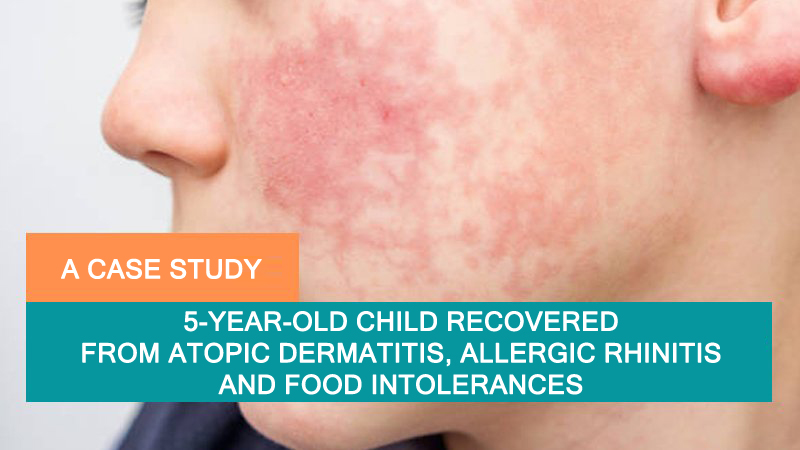
A 5-year-old girl had been experiencing eczema and multiple food intolerances since infancy. The exact causes of her symptoms could not be determined. According to her parents, she had been receiving formula milk since the age of two months, around which time the skin rashes first appeared. We can’t say that rashes are due to the use of formula milk because it is not scientifically proven. Her Allergic issues have been worsening since then, her parents went to the dermatologists where she was put on steroids, which is not a good thing for a child of such age.
Steroids may help reduce inflammation and relieve temporary rashes; however, long-term management of the underlying condition requires an appropriate treatment approach tailored to the child’s needs.Here comes our saviour Ayurveda, a 5000-year-age-old medicine which thoroughly focuses on the root cause of the disease.
Identifying potential factors contributing to your condition and guiding you toward a suitable Ayurvedic approach is the focus of IAFA®, an Ayurvedic institution specialising in allergy care, with experience serving over 50,000 patients globally and an offline presence in more than four cities across India. If you’re seeking guidance for managing your allergies, book an online consultation with IAFA® and schedule an appointment at your convenience.
Now, let’s explore the case study of a 5-year-old girl who underwent 3 months of regular Ayurvedic care at IAFA®, highlighting her treatment journey and progress with consistent therapy and adherence to the recommended care plan.
A Brief About the Disease
We can call this condition an “Allergy March” where Allergy starts with skin issues or nasal issues and slowly progresses into a three-angle issue called “Allergy March.” The first step in allergy march is Atopic dermatitis where we can see rashes on the skin from childhood or it can occur suddenly at any age. But usually, 1-6 years is the most prone age to Atopic Dermatitis. And the second stage of this disease is Allergic rhinitis and the third stage is Asthma. But here a noteworthy point is food plays a major role in the progression or triggering of this disease.
Evolution of Allergy in this Case Study
Allergy – As Per Ayurveda?
Ayurveda defines Allergy as “Srotasam Atipravruti,” which means body channels hyperactivity. Ayurveda states that there are 13 internal body channels and 7 external body channels in the body which may get exposed to various types of allergens and this hyperactivity is known as Allergy.
What Can We See in this Case Study?
In this case study, we can witness the hyperactivity of Annavaha Srotasam (channel for food), Rasavaha Srotasam (channel for digested food products) and Praanvaha Srotasam (channel for air). These three cases can be discussed further in detail in the final diagnosis part of our case study.
Symptoms
Sneezing
Coughing
Rashes on the skin
Red patches on the skin
Severe itching
Dry and flaky skin
More rashes in the flexor parts of the body
Bumps
Hives
Burning sensation
Oozes from the wound
Watery eyes
Runny nose
Causes
Allergy March is also called Atopic March where it started as Atopic dermatitis or Eczema in children and can progress into Asthma in around 50% of children and Food Allergies in around 33% of children. The causes may vary from child to child but the common causes can be the following:-
Genetic causes
Exposure to allergens such as dust and pollen.
Exposure to polluted air.
Certain foods like nuts, wheat, soy, fish, eggs and milk. In our case, she is allergic to tree nuts and peanuts.
Certain medications like penicillin can also cause allergies.
Some insect bites and wasp stings are also the culprits of allergy.
Weather changes
Stress
Final Diagnosis
She has been finally diagnosed with:-
1. Vicharchika (Atopic Dermatitis)
Ayurveda explains the symptoms of Atopic Dermatitis in the form of shloka mentioned below.
सकण्डूः पिडका श्यावा बहिस्राव विचर्चिका ॥
विचर्चिका कुष्ठ का लक्षण—जिसमें खुजली के साथ श्याव वर्ण की बहुत-सी पिडकाएँ होती हैं, उसे ‘विचर्चिका कुष्ठ’ कहते हैं।। २६ ॥।
2. Aahar Asatmyata (Food Intolerances)
The above shloka explains the Virudha nature of the food in which the doshas are vitiated upon the intake of certain foods. Virudha Aahar can refer to eating the wrong food, improper time, inappropriate amounts or eating the wrong food combinations.
यत्किञ्चित्दोषमुत्क्लेश्यनहरेत्तत्समासत: l
विरुद्धं
3. Vata-Kapha Pratishyaya (Allergic Rhinitis)
The below shloka explains the symptoms of Allergic Rhinitis like sneezing, runny nose, watery eyes etc,
The treatment of Allergy March includes both external and internal treatment.
External Treatment
For Nasal: Pratimarsha Nasya: Nasa Yoga Grutham: 2-3 drops of lukewarm Nasa Yoga Grutham in bilateral nostrils and 3-4 drops in the naval area twice a day, once in the morning and once at bedtime.
For Skin: IAFA E-5 Cell Repair Oil: Mix 10 ml of oil with extra virgin coconut oil and apply gently on the affected area twice a day and also during an allergic response.It helps keep skin moisturized, supports skin care, and nourishes dry, rough, and cracked skin.
Internal Treatment
IAFA® Swaras Chikitsa
Bhoomi Amla Swaras: 7.5 ml of swaras is taken with equal amounts of water 30 minutes before meals. It is useful for skin allergies and burning sensations in the body.
Aahar Amrutham Swaras: 7.5 ml of swaras is taken with equal amounts of water 30 minutes before meals. It is useful in gastrointestinal repair and care.
Haridrakhandam Churna: It is an ayurvedic classical medicine, half a teaspoon of churna twice a day with water.
Anthra Mithram Gulika: 1 tablet once a day. An hour after the meal. It is beneficial for gastrointestinal repair and is helpful to maintain digestive system wellness and the absorption surface of the gut.
Shishu Laxoherb: 1 ml of Laxoherb is taken with 20 ml of water once a day at bedtime.
Do’s (Pathya)
Consider giving plant-based milk instead of cow milk or formula milk.
The patient has to consume food that is easily digestible and will be gentle on the gut.
Consume green leafy veggies and include a lot of fibre-rich fruits and vegetables in the regular diet.
Advise the parents to feed her whole millet, ragi, buckwheats, corn and gluten-free oats.
Herbs like cumin, fennel, and curry leaves regularly increase the Agni, the digestive fire in the gut and also remove the excess AMA visha (toxins) from the body.
Don’ts (Apathya)
Avoid food that is high in lactose like dairy, cows’ milk, curd, or any sweet foods that contain milk content.
Avoid wheat and gluten foods that can be hard on the gut and may be the main reason behind skin allergies.
High-fat foods like butter, margarine, cream, greasy foods, and spiced and fried foods are heavy to digest and can release toxins if not properly digested.
Sea foods like fish and crabs can exaggerate allergic reactions, so it’s better to avoid them.
As she is allergic to nuts, it is advised to avoid nuts.
Fruits like bananas and avocados can trigger allergic reactions.
Home Remedies
1) Cumin water
Add 1-2 gm of cumin to the water and boil the water on a low flame for a few minutes. After you can see the change in the aroma and Color of the water, strain it out and drink the water.
2) Fennel water
Add 1-2 gms of fennel to the water and boil it on low flame so that the medicinal properties of fennel will not be evaporated and can be retained in the water. Strain it out and drink the water.
Cumin and fennel water enhances the digestive fire in the stomach and can help in protein breakdown. Thereby it helps to reduce the toxins and also the hypersensitivity reactions in the body.
Follow-Up #1
She was advised to use the medication for all three conditions. The child tolerated the medication well, and positive changes were observed during the course of treatment. The observations were as follows:-
Rashes were the main concern and the E-5 Oil along with extra virgin coconut oil worked well and the rashes were reduced instantly.
Bhoomi Amla Swaras and Aahar Amrutham Swaras worked well on the gut and the skin allergic symptoms like itching, and burning were reduced.
The symptoms of allergic rhinitis showed improvement during the course of treatment. Nasa Yoga Ghrutham, recommended by IAFA®, was included as part of the treatment approach to support the management of nasal allergy-related symptoms.
Follow-Up #2
The second month of treatment focuses on maintaining the patient’s improved condition and supporting the ongoing management of the disease, with the aim of achieving sustained symptom relief and better overall well-being.
Anthra Mithram Gulika can help in the enhancement of gut wellness and better absorption of food.
The medications mentioned above appeared to be well tolerated, with encouraging observations reported during the treatment. Therefore, IAFA® advised continuing the medications as recommended, with appropriate monitoring of the child’s progress.
Her skin allergies and nasal allergies were reduced to around 90% and the child was feeling better than before.
Follow-Up #3
The third month of medication is to eliminate the root cause of the disease and to ensure the patient from any kind of recurrence of the disease.
No visible rashes are found.
No sneezing and runny nose like before.
The food was easily digested and the child was feeling hungry and not bloated.
No itching or burning sensation on the skin.
A Quick Wrap-Up
The main reason behind Allergy March or Atopic March is the occurrence of Eczema or Atopic dermatitis in childhood. Eczema can progress to Food Allergy, Asthma and Allergic Rhinitis. So, Eczema should be treated properly in childhood otherwise it can become a serious issue. Symptoms can include sneezing, runny nose, itching and a burning sensation on the skin. The causes can be genetic factors, exposure to various allergens and many more as we mentioned above. But, no matter what the cause can be, the main aim of Ayurveda is to eliminate the root cause of the disease.
So, herbal medications include those medicines that work on the gut, strengthen the gut, eliminate toxins and boost immunity. So, she got treated within 3 months of the therapy and if you also suffer from any kind of allergies, Ayurveda has a solution for it.
To get guidance on managing allergies, book an appointment at IAFA®. Get your questions about Ayurveda answered, explore suitable treatment options, and make informed decisions about your health. This case highlights the treatment journey of a 5-year-old child and the progress reported during care. Visit IAFA® for expert guidance and take a step towards better health and well-being.
Vaidya Sahil Gupta completed his Bachelor of Ayurveda, Medicine and Surgery (B.A.M.S.) and a Master’s degree in Health Administration (M.H.A.) in India. He is a registered Ayurvedic practitioner and Vaidya in India, holding Registration No. 23780. He is the CEO and Founder of IAFA®. After completing his B.A.M.S., Vaidya Sahil Gupta began practicing Ayurveda, giving prime importance to the management of allergic and cancerous disorders. Read More About Vaidya Sahil Gupta.





 2590
 Share